0원리 — 절도 한 단어처럼 움직인다
준기 쌤, 1강 2강에서 덩어리 했잖아요. ving x, ved x. 이번엔 뭐예요?
선생 이번엔 더 큰 덩어리. 절이야.
준기 절이 뭔데요?
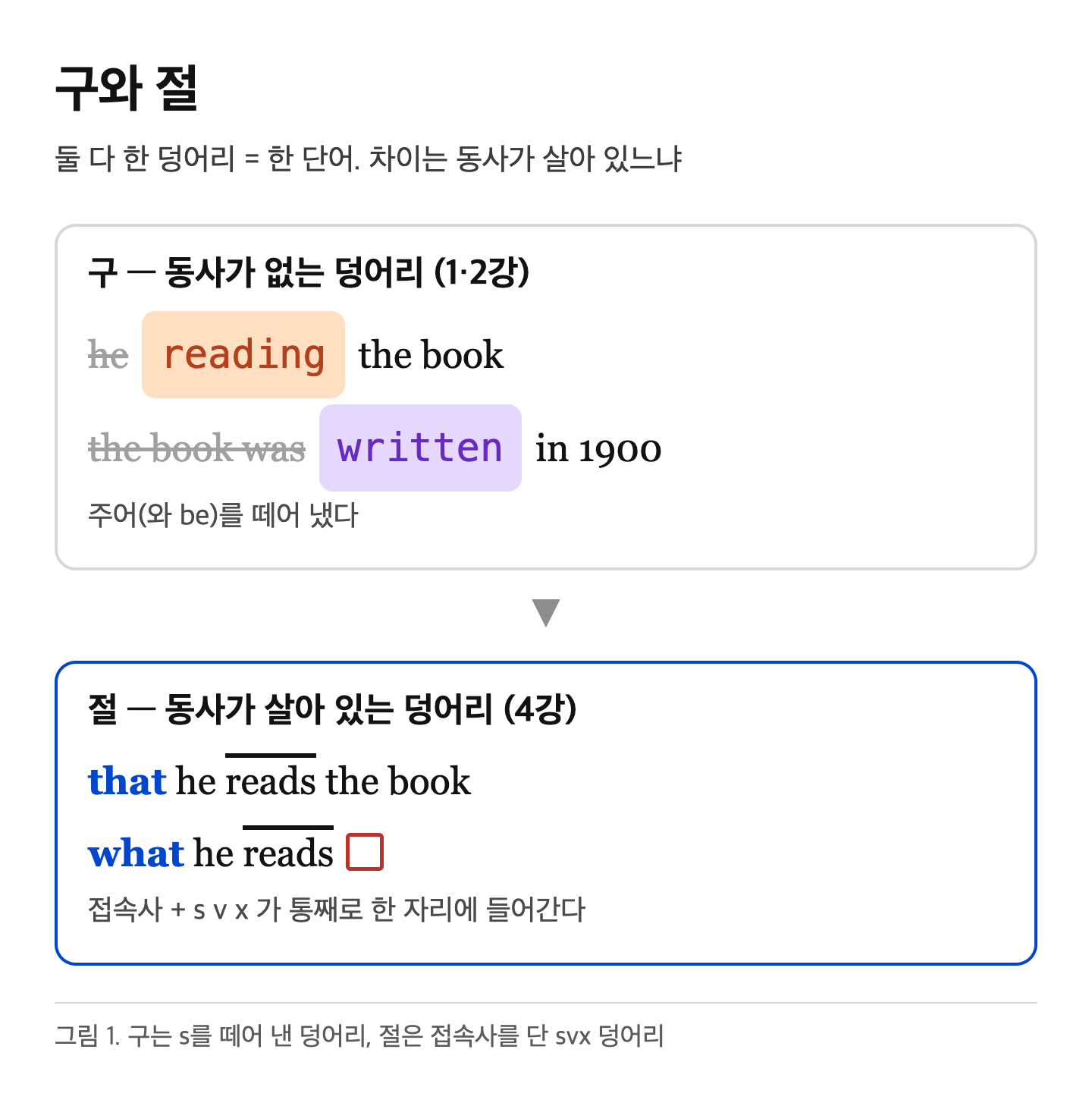
선생 한 줄로 말하면, 절은 svx야. 주어와 동사가 살아 있는 덩어리.
준기 ving x는 주어가 없었죠. 떼어 냈으니까.
선생 맞아. 구는 s를 떼어 낸 덩어리, 절은 s v가 그대로 남은 덩어리. 그런데 움직이는 방식은 똑같아. 앞에 접속사를 하나 달면, 그 svx 전체가 한 단어처럼 문장 속 자리에 들어가.
준기 그럼 문장에 동사가 두 개 나오겠네요.
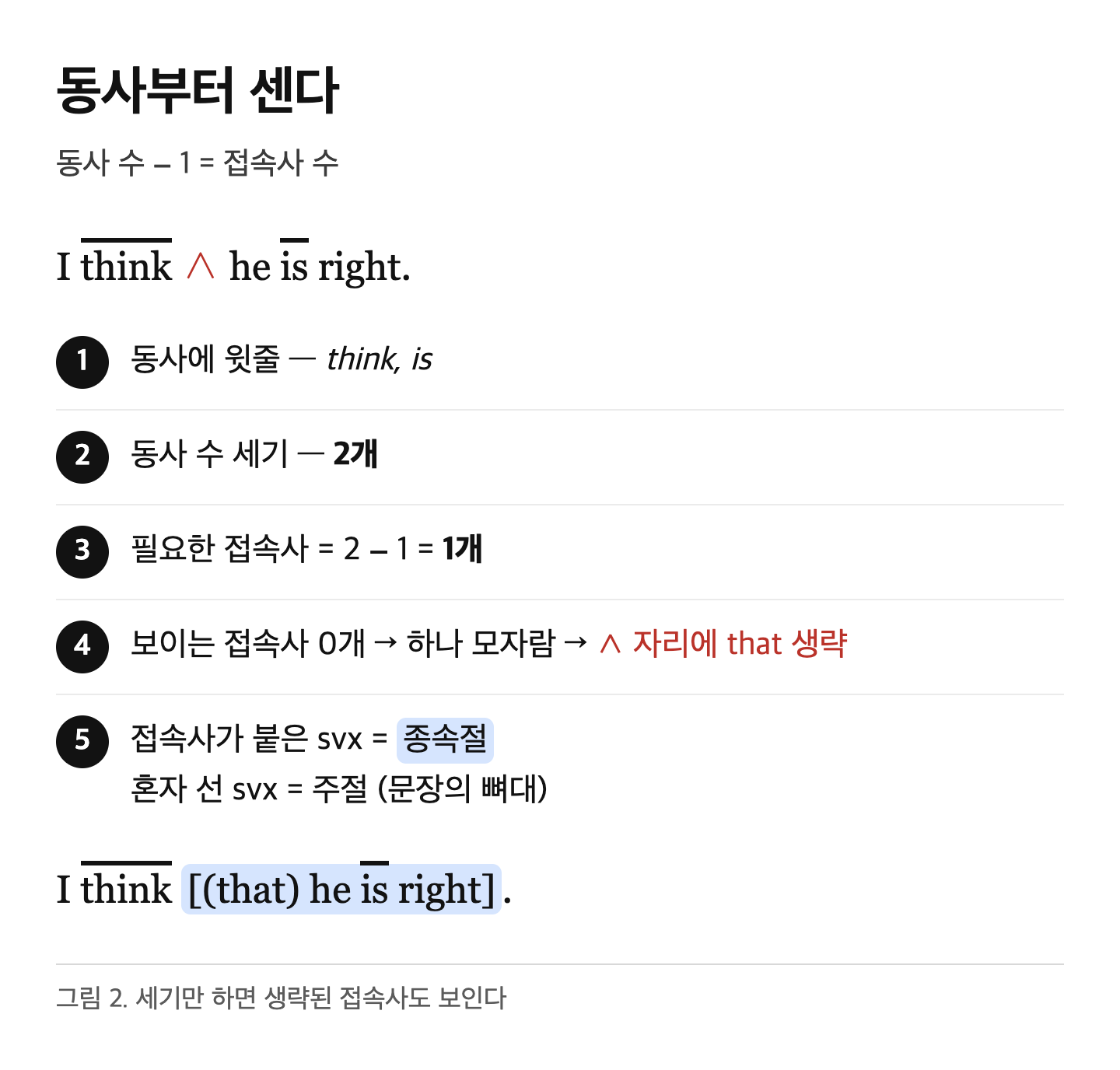
선생 그래서 동사부터 세. 이 시리즈에서 제일 중요한 습관이야.
0-1 주절과 종속절 — 동사부터 센다
선생 I think that he is right. 동사에 윗줄 그어 봐.
준기 think, is. 두 개요.
선생 동사가 두 개면 svx도 두 개야. 두 svx를 이어 주는 게 접속사. 그래서 규칙이 하나 나와.
동사 수 − 1 = 접속사 수
준기 동사 2개, 접속사 1개(that). 맞네요.
선생 접속사가 붙은 svx를 종속절, 접속사 없이 혼자 선 svx를 주절이라고 해. 주절이 문장의 뼈대고, 종속절은 그 뼈대의 한 자리에 들어간 덩어리야.
준기 I think he is right.는요? that이 없어요.
선생 동사 2개인데 접속사가 0개. 하나가 모자라지? 그럼 생략된 거야. I think [(that) he is right].
준기 세기만 하면 생략도 보이네요.
선생 종속절은 들어가는 자리에 따라 셋이야. 1·2강의 덩어리처럼.
- 명사 자리 → 명사절 [ ] — 이번 4강
- 형용사 자리 → 형용사절 ( ) — 5강, 관계사
- 부사 자리 → 부사절 < > — 6강, 조부시양이
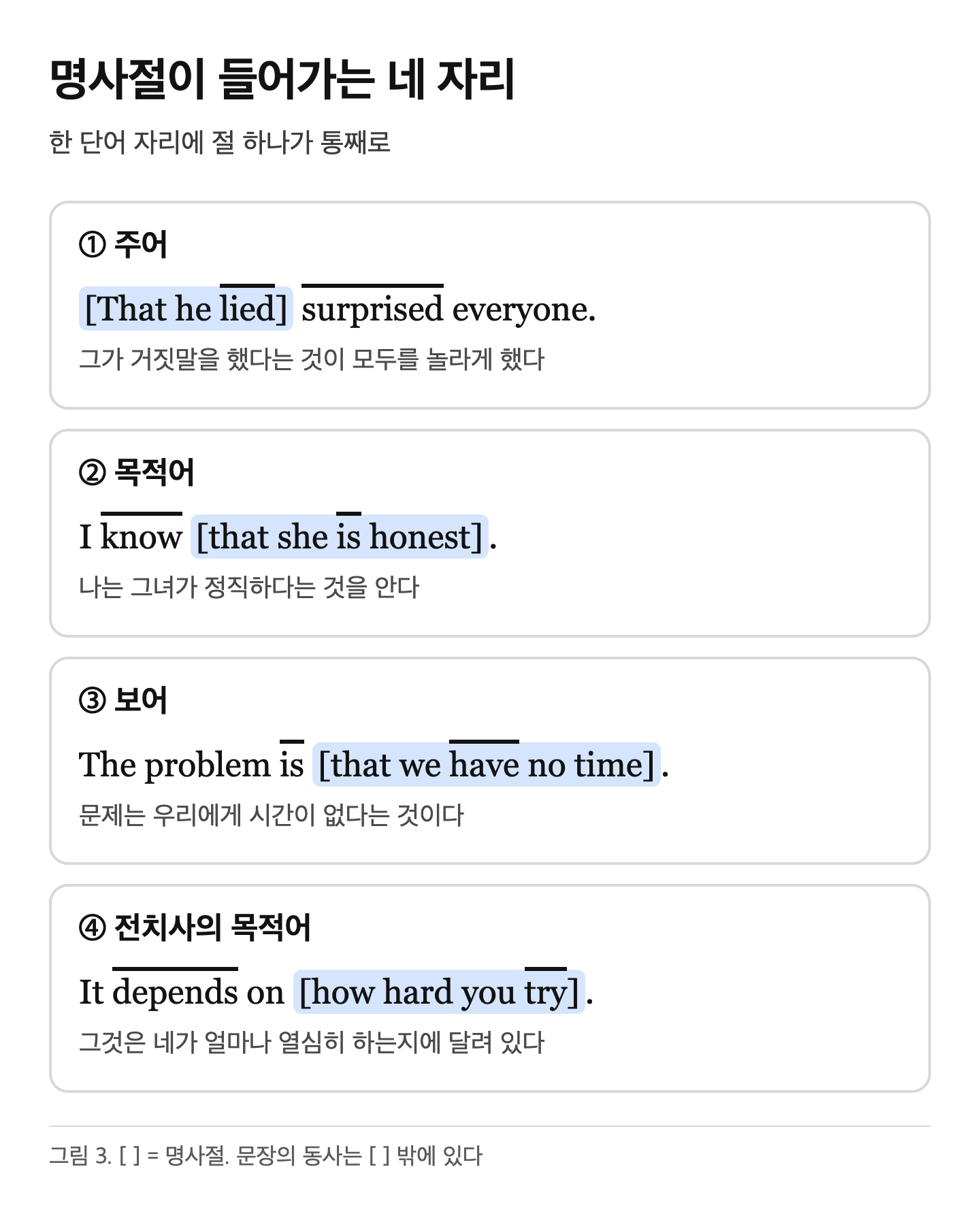
0-2 명사 자리 넷
선생 명사가 설 수 있는 자리는?
준기 주어, 목적어, 보어… 전치사 뒤요.
선생 그 네 자리에 절이 그대로 들어가.
- 주어: [That he lied] surprised everyone.
- 목적어: I know [that she is honest].
- 보어: The problem is [that we have no time].
- 전치사의 목적어: It depends on [how hard you try].
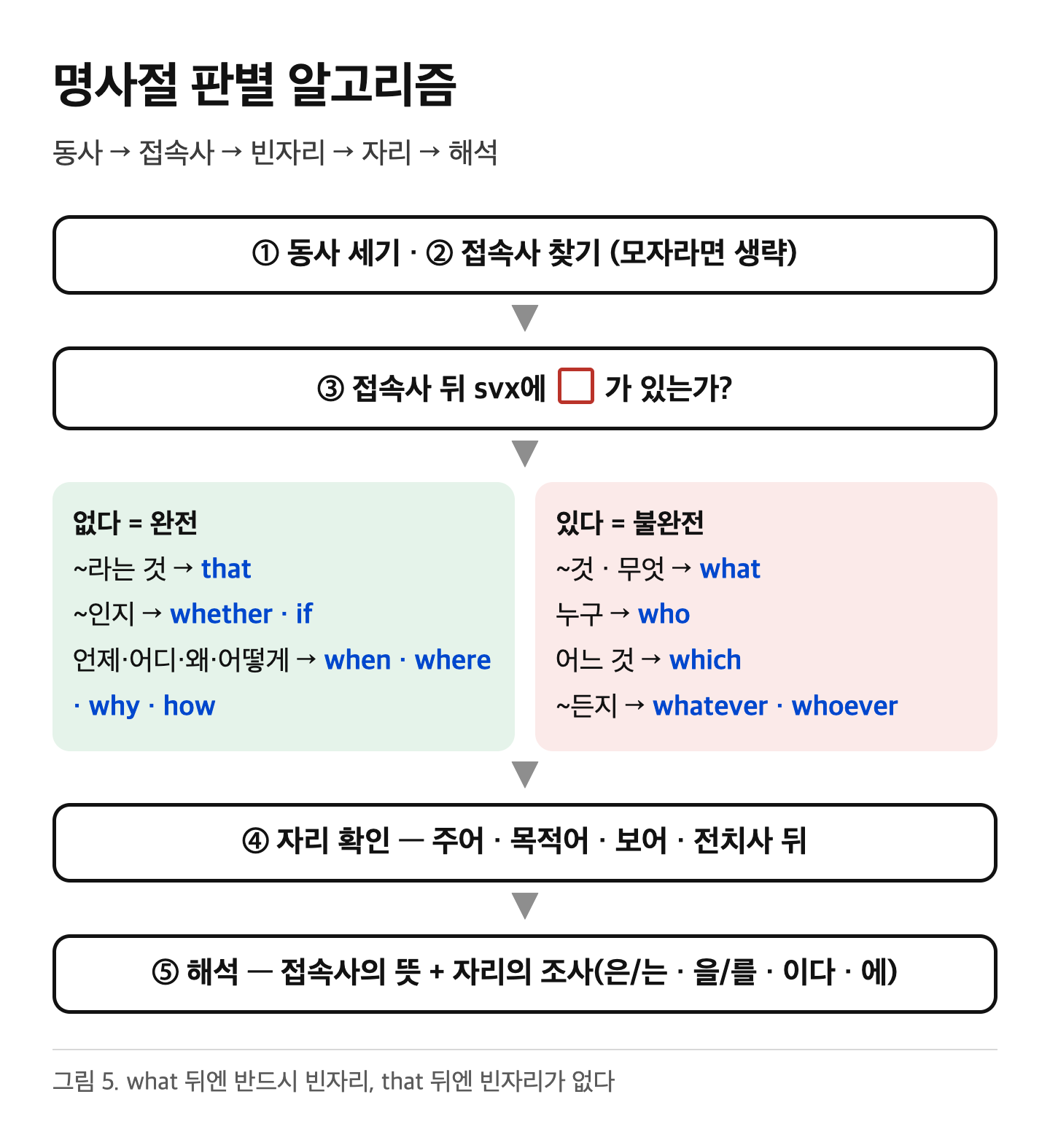
0-3 접속사 뒤를 본다 — 완전과 불완전
준기 접속사가 that, whether, what, who… 많잖아요. 어떻게 골라요?
선생 접속사 뒤의 svx를 봐. 자리가 다 찼으면 완전, 한 자리가 비었으면 불완전.
- 완전 → that(~것) · whether/if(~인지) · when, where, why, how(언제/어디서/왜/어떻게 ~하는지)
- 불완전 → what(~것/무엇) · who(누가) · which(어느 것) · whatever, whoever(~든지 그것/사람)
준기 빈자리는 어떻게 찾아요?
선생 빈자리에 ▢를 찍어. 무엇이 비느냐는 동사의 형식이 정해 줘.
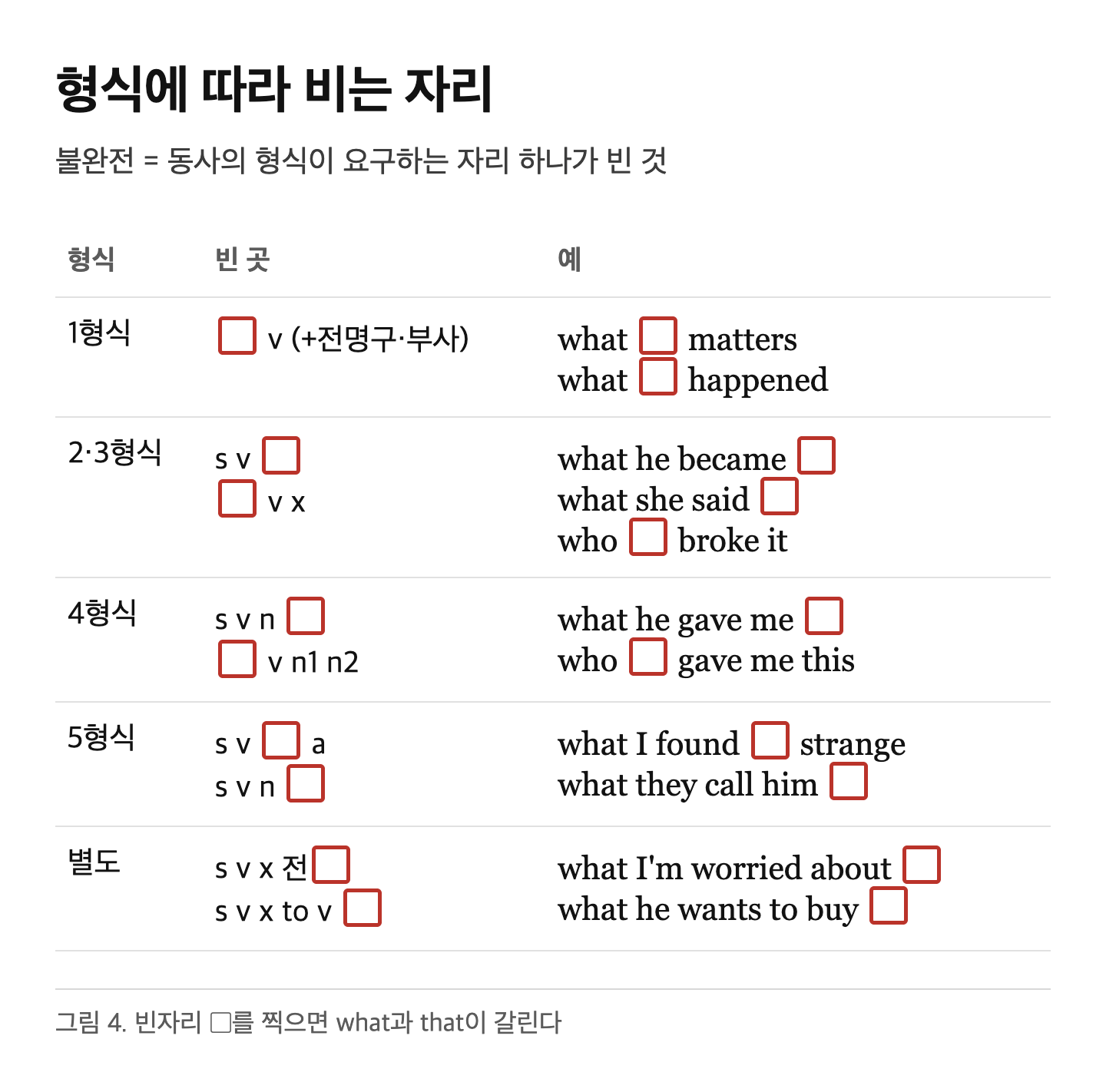
준기 뒤가 완전한데 what을 쓰면요?
선생 틀려. 수능 어법의 단골이 바로 그거야. what 뒤엔 반드시 ▢가 있어야 하고, that 뒤엔 ▢가 없어야 해.
0-4 의문사가 이끄는 절의 어순
준기 Who is he?는 의문문인데요.
선생 문장 속으로 들어가면 질문이 아니라 덩어리가 돼. 그래서 어순이 평서문으로 돌아와. Do you know [who he is]?
준기 is he가 아니라 he is.
선생 맞아. 의문사 + s v. 그런데 think, believe, guess처럼 생각을 묻는 동사면 의문사가 맨 앞으로 나가. Who do you think [▢ he is]? 예/아니오로 답할 질문이 아니니까.
0-5 it이 대신 서는 자리, 명사 옆에 붙는 that
선생 주어 절이 길면 영어는 뒤로 보내고 그 자리에 it을 세워. It is true [that he won the race]. 가주어 it, 진주어 that절.
준기 목적어도요?
선생 I found it strange [that nobody answered]. 가목적어 it. 5형식에서 목적어 절이 길면 보어 뒤로 보내.
준기 the fact that은요?
선생 명사 바로 뒤에 that절이 붙어 그 명사의 내용을 말해 주는 거야. the fact [that he is young] '그가 어리다는 사실'. 동격이라고 해. fact, news, idea, belief, view, sign, claim 같은 명사 뒤에 잘 와.
준기 그거 관계대명사 that이랑 똑같이 생겼잖아요.
선생 그래서 또 ▢를 봐. the news [that she got married] — 뒤가 완전, 동격. the news (that she told me ▢) — 뒤가 불완전, 관계대명사. 관계대명사는 5강에서 따로 해.
0-6 해석 공식
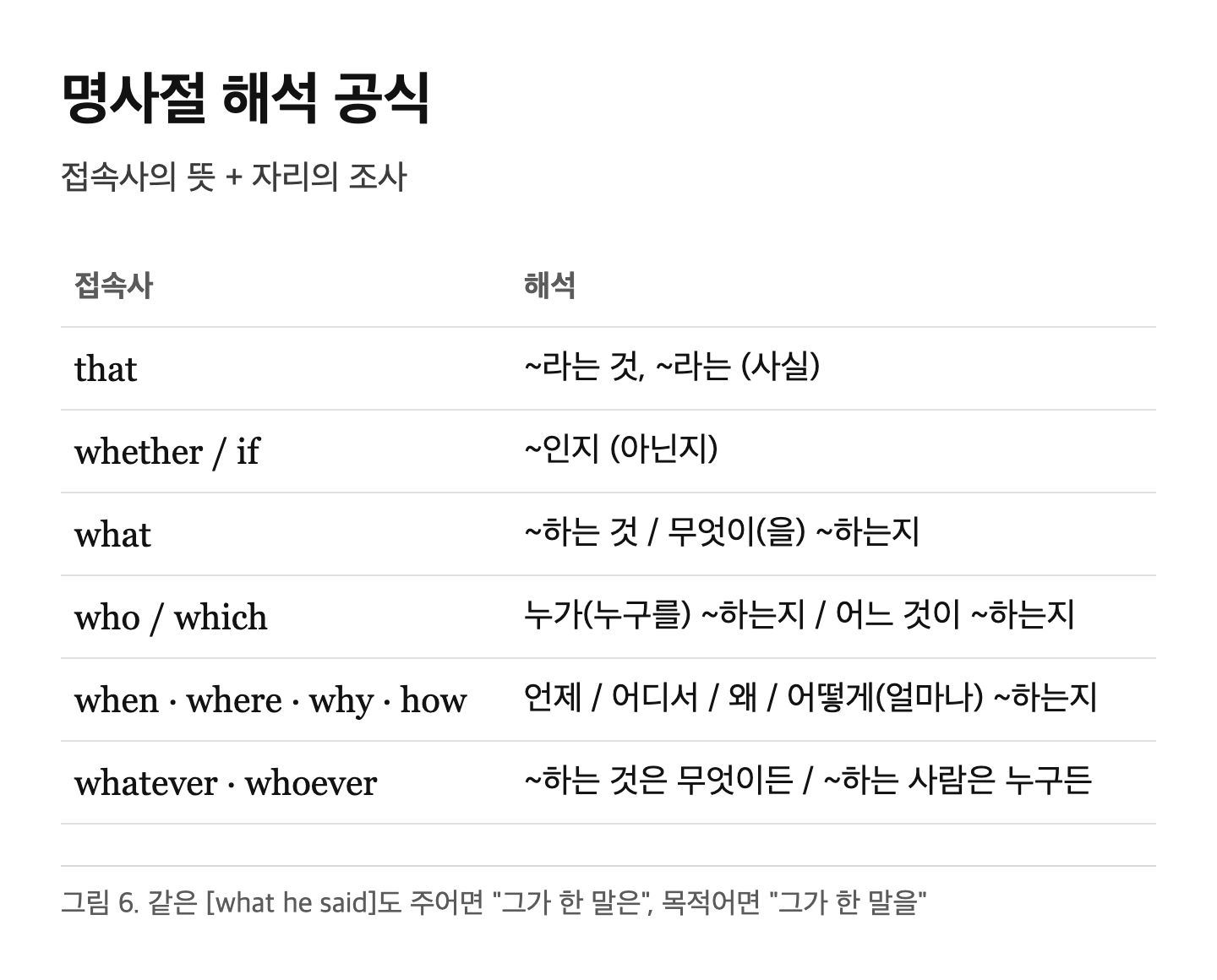
준기 원리는 이번에도 하나네요. 동사를 세고, 접속사 뒤를 보고, 자리를 본다.
선생 하나야. 절도 결국 한 단어. 이제 문장으로 손에 익히자.
역사 한 장면that은 원래 지시어였다. 옛 영어에서 "I know that: he is right(나는 그것을 안다: 그가 옳다)"처럼 앞의 '그것'이 뒤의 문장을 가리켰다. 가리키던 말이 점점 뒤 문장에 붙어 버린 것이 오늘의 접속사 that이다. 그래서 that절은 지금도 '그것'처럼, 한 단어처럼 움직인다.
1설명 — 쉬운 예문 30
명사절에 [ ]를 치고, 빈자리에 ▢를 찍고, 자리와 해석을 쓴다. 홀수는 보기, 짝수는 직접 해 본다.
1-1. 접속사 + 완전 10
1I know [that she is honest]. · 목적어 · 나는 그녀가 정직하다는 것을 안다.
2That he lied surprised everyone.
3The problem is [that we have no time]. · 보어 · 문제는 우리에게 시간이 없다는 것이다.
4I wonder whether it will rain tomorrow.
5[Whether he comes or not] doesn't matter. · 주어 · 그가 오는지 안 오는지는 중요하지 않다.
6Tell me when the movie starts.
7Nobody knows [why she left]. · 목적어 · 아무도 그녀가 왜 떠났는지 모른다.
8Do you remember where you put the key?
9I asked him [if he could help me]. · 4형식 직접목적어 · 나는 그에게 나를 도와줄 수 있는지 물었다.
10It depends on how hard you try.
실수 노트if절이 명사절인지 부사절인지는 자리로 가른다. I asked him [if he could help me]는 asked의 목적어 자리라 '~인지'. If he helps me, I'll finish it.은 빼도 문장이 남으니 부사절 '~라면'이다. 주어 자리와 전치사 뒤에는 if 대신 whether를 쓴다.
1-2. 접속사 + 불완전 10
11[What ▢ happened] was a mystery. · 주어 · 1형식 ▢ v · 일어난 일은 수수께끼였다.
12I don't know who broke the window.
13[What she said ▢] was true. · 주어 · 3형식 s v ▢ · 그녀가 말한 것은 사실이었다.
14I don't know what he wants to buy.
15Show me [what he gave you ▢]. · 직접목적어 · 4형식 s v n ▢ · 그가 너에게 준 것을 보여 줘.
16"Little Einstein" is what they call him.
17I couldn't believe [what he had become ▢]. · 목적어 · 2형식 s v ▢ · 나는 그가 어떤 사람이 되었는지 믿을 수 없었다.
18That's what I'm worried about.
19Choose [which ▢ looks better]. · 목적어 · 2형식 ▢ v a · 어느 것이 더 나아 보이는지 골라라.
20Whoever comes first will get a prize.
실수 노트what절 안의 동사를 문장의 동사로 읽는 실수가 많다. What she said was true.에서 동사는 said, was 둘. 접속사는 what 하나. [What she said ▢]가 주어 한 단어이고, 문장의 동사는 was다.
1-3. 가주어 · 동격 · 어순 · 생략 10
21It is true [that he won the race]. · 가주어 it, 진주어 · 그가 경주에서 이긴 것은 사실이다.
22It is not clear whether the plan will work.
23I heard the news [that she got married]. · 동격(뒤 완전) · 나는 그녀가 결혼했다는 소식을 들었다.
24The news that she told me was shocking.
25I think [▢ he is right]. · 목적어 · that 생략(동사 2, 접속사 0) · 나는 그가 옳다고 생각한다.
26She said she would call me later.
27Do you know [who he is]? · 목적어 · 의문사 + s v · 너는 그가 누구인지 아니?
28Who do you think he is?
29I found it strange [that nobody answered]. · 가목적어 it, 진목적어 · 나는 아무도 대답하지 않은 것이 이상했다.
30The fact that he is young doesn't matter.
더 알기what to do, how to swim처럼 의문사 뒤에 to v가 오면 s v가 없으니 절이 아니라 구다. 하지만 자리는 똑같이 명사 자리다. 나중에 the way 따위와 함께 다시 본다.
2연습 — 기출 문장 60
동사에 윗줄을 긋고, 명사절을 [ ]로 묶고, 빈자리에 ▢를 찍고, 자리와 해석을 쓴다. 쉬운 문장부터 어려운 문장 순서다. 함정 문장(명사절이 아닌 것)도 섞여 있다.
01She checked the recipe again but didn't know what went wrong. 2613-19
02Did you know that shadows are the color of the sky? 2603-20
03She added that she was excited to work with me. 2633-19
04Tim thought that taking care of a dog was much harder than he had expected. 2693-4345
05"This is exactly what we hoped for," she said. 2603-4345
06He couldn't even remember that he had scored more points than any other player in the game. 2613-4345
07Soon, Cora heard back from the girl herself that she would really like some apple butter, a local favorite in Appalachia. 2633-4345
08As she kept reading the post, she noticed that the family was in a nearby hospital. 2633-4345
09So, I am writing to ask where I can purchase pillows like those used at your hotel. 2613-18
10My hope is that with these pillows I can sleep as well at home as I did last week at your hotel. 2613-18
11However, it still looked too plain, and he had to admit that he had no idea what else to do. 2603-4345
12Andy learned that sharing his feelings with someone could help him manage them and find comfort. 2613-4345
13Instead of commanding you to find my keys, I might ask you where they are. 2633-22
14As a former student, I am extremely proud that the school has become one of the best schools in the local community. 2693-18
15Tom was happy that Martin finally came to see the value of the details he had once ignored. 2603-4345
16Her generosity showed that sharing the heart of a hometown created a friendship among strangers. 2633-4345
17It is known that taking a photo of wildlife requires a great deal of patience, confidence, and precision. 2613-20
18Between 1977 and 1988, she conducted field research in Kenya, discovering that vervet monkeys used different alarm calls for different predators such as leopards and snakes. 2613-26
19Be brutally honest and see what's actually there rather than what's expected. 2603-20
20It's what sharpens focus and fills ordinary moments with potential. 2693-23
21Listening to the needs of employees enables leaders to clearly identify what makes them feel heard. 2693-29
22Our natural instinct is to wonder what the Universe could possibly be expanding into. 2633-37
23That is to say that the reader finds the most when he knows just what he is looking for. 2613-22
24It is certainly true that, by addressing a question to a collective (crowd intelligence), you may get a good answer more easily than by, say, researching the literature or asking a philosopher. 2613-30
25If you want to get a shot of their momentous journey, you ought to learn about them as much as possible, including the fact that they usually travel during the cool, dark nights of July. 2613-20
26The fact that a pistol is used isn't about tradition; it's simply because athletes, like the rest of us, are slightly slower to react to the light than the sound. 2603-37
27The fact that I am a being with a body, embedded in a culturally rich situation, is no obstacle to my sometimes succeeding. 2633-20
28For Bebchuk, such situations do not pose a challenge to economist Milton Friedman's view that managers should aim at maximizing profits. 2603-24
29When new evidence does not support the idea that they have entertained, they reexamine it from alternative viewpoints. 2613-29
30In a consumer research classic, Maloney proposed that the disbelief most people experience when encountering exaggerated product claims is often overwhelmed by a natural curiosity. 2693-4142
31The joke-teller's skill lies in judging exactly how much of a surprise the audience is prepared to take. 2693-34
32He must make a series of assumptions about what they will understand, what their reference points are, and how relaxed they appear to be. 2693-34
33Scholars have demonstrated that the gestures hearing people produce while they are speaking are systematically made at the same time with speech such that language and gesture must be considered "co-expressive". 2633-38
34Whether or not it is a good reply is a function of whether or not it solves the problem. 2633-22
35Dennett suggests that it is useful to have "consideration-generator-squelchers": items that, once introduced, stop any further deliberation in its tracks. 2633-36
36Evidently, what is needful to learn in one society is not necessarily needful in another. 2613-33
37Cultural differences demonstrate that there is no absolute set of things to be learned; what a man should learn is a function of his culture. 2613-33
38And this prevents us from going on to assert that what a man should learn is a matter for him alone to decide. 2613-33
39What was inside the box ― customer histories, operational insights, proprietary knowledge ― represented control and competitive advantage. 2613-21
40In point of fact, the vast majority of what you know cannot be scientifically proven. 2603-39
41If there is anything we know about human nature in all of its history, art, literature, and the sciences, it is that traits vary. 2603-31
42The biggest obstacle for AI in real-world settings is that most human tasks aren't nearly as tidy in their rules and boundaries. 2603-33
43The main difference between the selection of cultural assets made for locals and the one made for tourists is that in the second case, only a small choice is made among the largest, most impressive and unique resources. 2693-35
44First of all, it is human beings who are gifted with the faculty of reasoning; secondly, human beings have free will to choose what is the best for them among many alternatives. 2633-35
45In other words, popular culture is what happens as mass culture gets pulled back into folk culture. 2603-34
46All the philosophical dilemmas about whether translation "reflects" or instead "transforms" what's in the original need to be swept aside. 2603-21
47And while the technologies of cultural storage and distribution have changed, the laws governing how culture works ─ how it is preserved, transmitted, exchanged, and recovered ─ haven't. 2603-22
48This comes on top of the genetic lottery as we inherit about half of our dad's genes and half of our mom's, but which of our dad's genes and which of our mom's genes we inherit is random, like a deck of shuffled cards. 2603-38
49We all carry variants of nature's instruction manual for who we can become ─ differing in roughly one out of every thousand nucleotides. 2603-38
50The explanation for why it's uncomfortable to have everyone's eyes on you is probably that, for almost all of our evolution, it's been extremely important not to be excluded from the group. 2693-31
51This incentive sends a very different signal about what the manager is looking for: it's about being fast, which comes at the expense of quality of care. 2693-36
52Simple "one-aspect" compensation sends a clear message to the workers: concentrate on what we're paying you for and ignore everything else. 2693-36
53Since the 1950s or '60s, theatrical designing moved toward a concept that we call selective visibility, which simply refers to revealing to an audience only what needs to be seen. 2693-40
54There is also no reason to assume that what we see in the mirror must form a coherent whole. 2633-4142
55It is as though it allows us to see more clearly what isn't there. 2633-4142
56In fact, they are as significant for what they don't reflect ─ for their exclusions and distortions ─ as for what they do. 2633-4142
57A nuanced version of this alternative is that, in fact, the life we see around us as humans is not even typical of the vast majority of biomass on Earth. 2613-4142
58Convincing consumers that the claims about a new product are true is not necessary to create interest in product trial. 2693-4142
59When painters turn to the essentially musical notion of rhythm in order to define what they consider one of the necessary elements of their own art, it is a sure sign that this art itself is trying to overstep its natural limits. 2613-34
60Darwin understood that since inheritance is conservative, it is in the nature of the organism to impose itself on the surroundings, producing many highly similar but variable offspring regardless of the nature of the conditions. 2633-29
3실전 — 수능·모의고사 어법 5문항
명사절 접속사가 정답이거나, 학생들이 가장 많이 속은 함정이 명사절인 문항만 골랐다. 동사를 세고, 접속사 뒤에 ▢가 있는지 본 다음, 남은 밑줄을 판단한다.
실전 1. 다음 글의 밑줄 친 부분 중, 어법상 틀린 것은? 1713-28 · 정답률 51% · 2017년 11월 고3 (2018학년도 수능)
Psychologists who study giving behavior ① have noticed that some people give substantial amounts to one or two charities, while others give small amounts to many charities. Those who donate to one or two charities seek evidence about what the charity is doing and ② what it is really having a positive impact. If the evidence indicates that the charity is really helping others, they make a substantial donation. Those who give small amounts to many charities are not so interested in whether what they are ③ doing helps others ─ psychologists call them warm glow givers. Knowing that they are giving makes ④ them feel good, regardless of the impact of their donation. In many cases the donation is so small ─ $10 or less ─ that if they stopped ⑤ to think, they would realize that the cost of processing the donation is likely to exceed any benefit it brings to the charity.
실전 2. 다음 글의 밑줄 친 부분 중, 어법상 틀린 것은? 2113-29 · 정답률 52% · 2021년 11월 고3 (2022학년도 수능)
Like whole individuals, cells have a life span. During their life cycle (cell cycle), cell size, shape, and metabolic activities can change dramatically. A cell is "born" as a twin when its mother cell divides, ① producing two daughter cells. Each daughter cell is smaller than the mother cell, and except for unusual cases, each grows until it becomes as large as the mother cell ② was. During this time, the cell absorbs water, sugars, amino acids, and other nutrients and assembles them into new, living protoplasm. After the cell has grown to the proper size, its metabolism shifts as it either prepares to divide or matures and ③ differentiates into a specialized cell. Both growth and development require a complex and dynamic set of interactions involving all cell parts. ④ What cell metabolism and structure should be complex would not be surprising, but actually, they are rather simple and logical. Even the most complex cell has only a small number of parts, each ⑤ responsible for a distinct, well-defined aspect of cell life. * metabolic: 물질대사의 ** protoplasm: 원형질
실전 3. 다음 글의 밑줄 친 부분 중, 어법상 틀린 것은? 2333-29 · 정답률 42% · 2023년 3월 고3
From the 8th to the 12th century CE, while Europe suffered the perhaps overdramatically named Dark Ages, science on planet Earth could be found almost ① exclusively in the Islamic world. This science was not exactly like our science today, but it was surely antecedent to ② it and was nonetheless an activity aimed at knowing about the world. Muslim rulers granted scientific institutions tremendous resources, such as libraries, observatories, and hospitals. Great schools in all the cities ③ covering the Arabic Near East and Northern Africa (and even into Spain) trained generations of scholars. Almost every word in the modern scientific lexicon that begins with the prefix "al" ④ owes its origins to Islamic science — algorithm, alchemy, alcohol, alkali, algebra. And then, just over 400 years after it started, it ground to an apparent halt, and it would be a few hundred years, give or take, before ⑤ that we would today unmistakably recognize as science appeared in Europe — with Galileo, Kepler, and, a bit later, Newton. * antecedent: 선행하는 ** lexicon: 어휘 (목록) *** give or take: 대략
실전 4. 다음 글의 밑줄 친 부분 중, 어법상 틀린 것은? 1613-28 · 정답률 48% · ④ what 오답 30% · 2016년 11월 고3 (2017학년도 수능)
When people face real adversity ─ disease, unemployment, or the disabilities of age ─ affection from a pet takes on new meaning. A pet's continuing affection becomes crucially important for ① those enduring hardship because it reassures them that their core essence has not been damaged. Thus pets are important in the treatment of ② depressed or chronically ill patients. In addition, pets are ③ used to great advantage with the institutionalized aged. In such institutions it is difficult for the staff to retain optimism when all the patients are declining in health. Children who visit cannot help but remember ④ what their parents or grandparents once were and be depressed by their incapacities. Animals, however, have no expectations about mental capacity. They do not worship youth. They have no memories about what the aged once ⑤ was and greet them as if they were children. An old man holding a puppy can relive a childhood moment with complete accuracy. His joy and the animal's response are the same.
실전 5. 다음 글의 밑줄 친 부분 중, 어법상 틀린 것은? 2613-29 · 정답률 80% · 2026년 11월 고3 (2027학년도 수능)
People show a tendency to trust ideas that correspond to their beliefs, even though there is little or no objective evidence to support them. Such ideas may eventually turn out to be false, if the assumptions underlying them ① largely rely on subjective observations. Careful thinkers thus try to test their existing beliefs, rather than simply maintaining them. When new evidence does not support the idea that they have entertained, they reexamine ② it from alternative viewpoints. This inspires them to go about challenging the problematic belief. Therefore, ③ think reflectively about the existing beliefs helps people adjust them according to available evidence. Furthermore, it enables people to become less likely to accept new ideas just because they are tempting or consistent with ④ what they have long believed. Although individuals differ considerably in their belief systems, those who objectify and test their own beliefs tend to think more critically than those who ⑤ do not.
✓정답·해설
설명 짝수 정답
2. [That he lied] surprised everyone. · 주어 · 그가 거짓말을 했다는 것이 모두를 놀라게 했다.
4. I wonder [whether it will rain tomorrow]. · 목적어 · 나는 내일 비가 올지 궁금하다.
6. Tell me [when the movie starts]. · 직접목적어 · 영화가 언제 시작하는지 말해 줘.
8. Do you remember [where you put the key]? · 목적어 · 너는 열쇠를 어디에 두었는지 기억하니?
10. It depends on [how hard you try]. · 전치사의 목적어 · 그것은 네가 얼마나 열심히 노력하는지에 달려 있다.
12. I don't know [who ▢ broke the window]. · 목적어 · 3형식 ▢ v x · 나는 누가 창문을 깼는지 모른다.
14. I don't know [what he wants to buy ▢]. · 목적어 · s v x to v ▢ · 나는 그가 무엇을 사고 싶어 하는지 모른다.
16. "Little Einstein" is [what they call him ▢]. · 보어 · 5형식 s v n ▢ · '꼬마 아인슈타인'이 사람들이 그를 부르는 말이다.
18. That's [what I'm worried about ▢]. · 보어 · s v x 전▢ · 그게 내가 걱정하는 것이다.
20. [Whoever ▢ comes first] will get a prize. · 주어 · 1형식 ▢ v · 먼저 오는 사람은 누구든 상을 받을 것이다.
22. It is not clear [whether the plan will work]. · 가주어 it, 진주어 · 그 계획이 효과가 있을지는 분명하지 않다.
24. The news (that she told me ▢) was shocking. · 명사절 아님. 뒤가 불완전(told me ▢)이니 관계대명사, 형용사절(5강) · 그녀가 나에게 말해 준 소식은 충격적이었다.
26. She said [▢ she would call me later]. · 목적어 · that 생략(동사 2, 접속사 0) · 그녀는 나중에 나에게 전화하겠다고 말했다.
28. Who do you think [▢ he is ▢]? · think 목적어 · 생각 동사라 의문사가 맨 앞으로 · 너는 그가 누구라고 생각하니?
30. The fact [that he is young] doesn't matter. · 동격(뒤 완전) · 그가 어리다는 사실은 중요하지 않다.
연습 60 정답
01 [what ▢ went wrong] — 목적어 · 불완전 1형식 ▢ v
그녀는 요리법을 다시 확인했지만 무엇이 잘못되었는지 알지 못했다.
02 [that shadows are the color of the sky] — 목적어 · 완전
그림자가 하늘색이라는 것을 알았는가?
03 [that she was excited to work with me] — 목적어 · 완전
그녀는 나와 함께 일하게 되어 신난다고 덧붙였다.
04 [that taking care of a dog was much harder than he had expected] — 목적어 · 완전
Tim은 개를 돌보는 것이 예상했던 것보다 훨씬 더 힘들다고 생각했다.
05 [what we hoped for ▢] — 보어 · 불완전 s v 전▢
"이게 바로 우리가 바라던 것이에요." 그녀가 말했다.
06 [that he had scored more points than any other player in the game] — 목적어 · 완전
그는 자기가 그 경기에서 다른 어떤 선수보다 많은 점수를 냈다는 것조차 기억하지 못했다.
07 [that she would really like some apple butter, a local favorite in Appalachia] — heard back의 목적어 · 완전 · from the girl herself가 끼어들어 목적어가 뒤로 밀림
곧 Cora는 그 소녀에게서 직접, 애팔래치아 지역에서 즐겨 먹는 사과 버터를 정말 먹고 싶다는 답을 들었다.
08 [that the family was in a nearby hospital] — 목적어 · 완전
그 게시글을 계속 읽다가 그녀는 그 가족이 근처 병원에 있다는 것을 알아차렸다.
09 [where I can purchase pillows like those used at your hotel] — to ask의 목적어 · 완전(의문부사)
그래서 귀하의 호텔에서 쓰는 것과 같은 베개를 어디서 살 수 있는지 여쭈려고 이 글을 씁니다.
10 [that with these pillows I can sleep as well at home as I did last week at your hotel] — 보어 · 완전
제 바람은 이 베개로 지난주 귀하의 호텔에서처럼 집에서도 잘 자는 것입니다.
11 [that he had no idea what else to do] — 목적어 · 완전 / what else to do는 의문사 + to v, 절이 아닌 명사구
하지만 그것은 여전히 너무 밋밋해 보였고, 그는 달리 무엇을 해야 할지 모르겠다는 것을 인정할 수밖에 없었다.
12 [that sharing his feelings with someone could help him manage them and find comfort] — 목적어 · 완전
Andy는 자기 감정을 누군가와 나누는 것이 감정을 다스리고 위안을 얻는 데 도움이 될 수 있다는 것을 배웠다.
13 [where they are] — 4형식 ask you의 직접목적어 · 완전 · 의문사 + s v 어순
내 열쇠를 찾으라고 명령하는 대신, 나는 너에게 그것이 어디 있는지 물을 수도 있다.
14 [that the school has become one of the best schools in the local community] — 감정 형용사 proud 뒤 · 완전
졸업생으로서 저는 학교가 지역 사회 최고의 학교 중 하나가 된 것이 매우 자랑스럽습니다.
15 [that Martin finally came to see the value of the details (he had once ignored ▢)] — happy 뒤 · 완전 / 안의 ( )는 관계대명사 생략 형용사절(5강)
Tom은 Martin이 한때 무시했던 세부의 가치를 마침내 알게 된 것이 기뻤다.
16 [that sharing the heart of a hometown created a friendship among strangers] — 목적어 · 완전
그녀의 너그러움은 고향의 마음을 나누는 것이 낯선 이들 사이에 우정을 만들어 냈다는 것을 보여 주었다.
17 It … [that taking a photo of wildlife requires …] — 가주어 it, 진주어 · 완전
야생동물 사진을 찍는 데 많은 인내와 자신감, 정밀함이 필요하다는 것은 알려져 있다.
18 [that vervet monkeys used different alarm calls for different predators …] — 동명사 discovering의 목적어 · 완전
1977년에서 1988년까지 그녀는 케냐에서 현장 연구를 하며, 버빗원숭이가 표범과 뱀 같은 포식자마다 다른 경고음을 쓴다는 것을 발견했다.
19 [what ▢'s actually there] / [what ▢'s expected] — see의 목적어 둘 · 불완전 ▢ v
지독할 만큼 정직하게, 기대되는 것이 아니라 실제로 거기 있는 것을 보라.
20 [what ▢ sharpens focus and fills ordinary moments with potential] — 보어 · 불완전 ▢ v x (동사 2개가 and로 병렬)
그것(도파민)이 바로 집중력을 날카롭게 하고 평범한 순간을 가능성으로 채우는 것이다.
21 [what ▢ makes them feel heard] — identify의 목적어 · 불완전 5형식 ▢ v n x
직원의 필요에 귀 기울이면 리더는 무엇이 직원으로 하여금 존중받는다고 느끼게 하는지 분명히 파악할 수 있다.
22 [what the Universe could possibly be expanding into ▢] — wonder의 목적어 · 불완전 s v 전▢
우리의 자연스러운 본능은 우주가 도대체 무엇 속으로 팽창하고 있는지 궁금해하는 것이다.
23 [that the reader finds the most <when he knows just [what he is looking for ▢]>] — 보어(is to say) · 완전, 그 안에 부사절, 다시 그 안에 명사절
다시 말해, 독자는 자기가 무엇을 찾고 있는지 정확히 알 때 가장 많이 발견한다는 것이다.
24 It … [that, by addressing a question to a collective …, you may get a good answer …] — 가주어 it, 진주어 · that 바로 뒤에 삽입 전명구
집단(군중 지성)에 질문을 던지면 문헌을 조사하거나 철학자에게 묻는 것보다 더 쉽게 좋은 답을 얻을 수도 있다는 것은 분명 사실이다.
25 the fact [that they usually travel during the cool, dark nights of July] — 동격 · 완전
그들의 중대한 여정을 찍고 싶다면, 그들이 대개 7월의 서늘하고 어두운 밤에 이동한다는 사실을 포함해 그들에 대해 되도록 많이 알아야 한다.
26 The fact [that a pistol is used] — 동격 · 주어 덩어리, 동사 isn't
피스톨이 쓰인다는 사실은 전통 때문이 아니다. 그저 선수들도 다른 우리처럼 소리보다 빛에 조금 더 늦게 반응하기 때문이다.
27 The fact [that I am a being with a body, embedded in a culturally rich situation,] — 동격 · 주어 덩어리, 동사 is
내가 문화적으로 풍부한 상황에 놓인, 몸을 가진 존재라는 사실은 내가 때때로 성공하는 데 전혀 장애가 되지 않는다.
28 view [that managers should aim at maximizing profits] — 동격 · 완전
Bebchuk에게 그런 상황은 경영자가 이윤 극대화를 목표로 해야 한다는 경제학자 밀턴 프리드먼의 견해에 대한 도전이 되지 않는다.
29 함정. the idea (that they have entertained ▢) — 뒤가 불완전(entertained의 목적어 ▢)이니 동격이 아니라 관계대명사, 형용사절(5강)
새 증거가 그들이 품어 온 생각을 뒷받침하지 않으면, 그들은 그것을 다른 관점에서 다시 검토한다.
30 [that the disbelief (most people experience ▢ <when encountering exaggerated product claims>) is often overwhelmed by a natural curiosity] — proposed의 목적어 · 완전 · 안에 목적격 생략 형용사절, 명사절의 동사는 is
소비자 연구의 고전에서 Maloney는, 사람들이 과장된 제품 광고를 접할 때 느끼는 불신이 흔히 타고난 호기심에 압도된다고 주장했다.
31 [how much of a surprise the audience is prepared to take ▢] — 동명사 judging의 목적어 · 불완전 s v x to v ▢ (how much of a surprise가 take의 목적어)
농담하는 사람의 기술은 청중이 얼마만큼의 놀라움을 받아들일 준비가 되어 있는지 정확히 판단하는 데 있다.
32 [what they will understand ▢], [what their reference points are ▢], [how relaxed they appear to be] — about의 목적어 셋 병렬 · 불완전 3형식 / 불완전 2형식 / 완전(how + 형용사)
그는 청중이 무엇을 이해할지, 그들의 기준점이 무엇인지, 그들이 얼마나 편안해 보이는지에 대해 여러 가정을 세워야 한다.
33 [that the gestures (hearing people produce ▢ <while they are speaking>) are systematically made at the same time with speech <such that …>] — demonstrated의 목적어 · 완전 · 함정: hearing people은 '청인(듣는 사람들)', hearing은 동사가 아니다. 동사 5개(demonstrated, produce, are speaking, are made, must be considered) − 1 = 접속사 4개(that, 생략, while, such that)
학자들은 청인이 말하는 동안 만드는 몸짓이 말과 체계적으로 동시에 만들어지므로, 언어와 몸짓을 '함께 표현하는' 것으로 봐야 한다는 것을 입증했다.
34 [Whether or not it is a good reply] / [whether or not it solves the problem] — 주어 / 전치사 of의 목적어 · 완전 · 주어 자리와 전치사 뒤라 if가 아니라 whether
그것이 좋은 대답인지 아닌지는 그것이 문제를 해결하는지 아닌지에 달려 있다.
35 [that it is useful to have "consideration-generator-squelchers"] — suggests의 목적어 · 완전 · 안에 가주어 it … to v / 콜론 뒤 items (that ▢, once introduced, stop …)는 형용사절
Dennett은 '숙고 억제 장치', 곧 한번 꺼내 놓으면 더 이상의 숙고를 그 자리에서 멈추게 하는 것들을 갖는 것이 유용하다고 말한다.
36 [what ▢ is needful to learn in one society] — 주어 · 불완전 ▢ v x · 문장의 동사는 is not
분명히, 한 사회에서 배울 필요가 있는 것이 다른 사회에서도 꼭 필요한 것은 아니다.
37 [that there is no absolute set of things to be learned] / [what a man should learn ▢] — 목적어 / 주어 · 완전 / 불완전 3형식
문화 차이는 배워야 할 절대적인 것들의 묶음이 없다는 것을 보여 준다. 사람이 무엇을 배워야 하는지는 그의 문화에 따라 정해진다.
38 [that [what a man should learn ▢] is a matter for him alone to decide] — assert의 목적어, 그 안의 주어도 명사절 · 절 안의 절
그리고 이것은 사람이 무엇을 배워야 하는지는 그 혼자 결정할 문제라고 주장하는 데까지 나아가지 못하게 막는다.
39 [What ▢ was inside the box ― customer histories, operational insights, proprietary knowledge ―] — 주어 · 불완전 ▢ v · 대시 삽입 뒤 represented가 문장의 동사
상자 안에 있던 것, 즉 고객 이력, 운영 통찰, 독점 지식은 통제력과 경쟁 우위를 뜻했다.
40 [what you know ▢] — 전치사 of의 목적어 · 불완전 3형식
사실 당신이 아는 것의 대부분은 과학적으로 증명될 수 없다.
41 [that traits vary] — 보어 · 완전 / 앞의 anything (we know ▢)는 형용사절
역사, 예술, 문학, 과학 전체에 걸쳐 우리가 인간 본성에 대해 아는 것이 있다면, 그것은 특성이 다양하다는 것이다.
42 [that most human tasks aren't nearly as tidy in their rules and boundaries] — 보어 · 완전
현실 환경에서 AI의 가장 큰 장애물은 대부분의 인간 과업이 규칙과 경계 면에서 전혀 그만큼 깔끔하지 않다는 것이다.
43 [that in the second case, only a small choice is made among …] — 보어 · 완전 · 주어가 길어 동사 is를 먼저 찾을 것
현지인을 위해 고른 문화 자산과 관광객을 위해 고른 것의 주된 차이는, 두 번째 경우에는 가장 크고 인상적이며 독특한 자원 가운데 아주 적은 것만 고른다는 것이다.
44 [what ▢ is the best for them among many alternatives] — choose의 목적어 · 불완전 ▢ v x / 앞의 it is ~ who는 강조 구문
첫째, 추론 능력을 타고난 것은 바로 인간이다. 둘째, 인간은 많은 대안 가운데 자기에게 가장 좋은 것을 고를 자유 의지가 있다.
45 [what ▢ happens <as mass culture gets pulled back into folk culture>] — 보어 · 불완전 1형식 ▢ v
다시 말해, 대중문화란 대량 문화가 민속 문화 속으로 다시 끌려 들어갈 때 일어나는 것이다.
46 [whether translation "reflects" or instead "transforms" [what ▢'s in the original]] — about의 목적어, 그 안의 목적어도 what절 · 문장의 동사는 need
번역이 원문에 있는 것을 '반영'하는지 아니면 '변형'하는지에 관한 철학적 딜레마는 모두 치워 버려야 한다.
47 [how culture works] ─ [how it is preserved, transmitted, exchanged, and recovered] ─ — governing의 목적어, 대시 안은 같은 말을 풀어 쓴 병렬 · 문장의 동사는 haven't (changed)
문화를 저장하고 유통하는 기술은 바뀌었지만, 문화가 어떻게 작동하는지, 곧 그것이 어떻게 보존되고 전달되고 교환되고 회복되는지를 지배하는 법칙은 바뀌지 않았다.
48 [which of our dad's genes and which of our mom's genes we inherit ▢] — but 뒤 절의 주어 · 불완전 3형식 · 동사 is
이것은 아빠 유전자의 절반, 엄마 유전자의 절반을 물려받는 유전자 복권에 더해지는 일이다. 그런데 아빠의 어떤 유전자와 엄마의 어떤 유전자를 물려받는지는 잘 섞인 카드 한 벌처럼 무작위다.
49 [who we can become ▢] — 전치사 for의 목적어 · 불완전 2형식 s v ▢
우리는 모두, 우리가 어떤 사람이 될 수 있는지를 적은 자연의 설명서를 저마다 조금씩 다른 판본으로 지니고 있다. 그 차이는 뉴클레오타이드 천 개 중 하나꼴이다.
50 [why it's uncomfortable to have everyone's eyes on you] / [that, for almost all of our evolution, it's been extremely important …] — for의 목적어 / 보어 · 둘 다 완전, 둘 다 안에 가주어 it
모든 사람의 시선이 자신에게 쏠리면 왜 불편한지에 대한 설명은 아마도, 진화의 거의 모든 기간 동안 집단에서 배제되지 않는 것이 몹시 중요했다는 것이다.
51 [what the manager is looking for ▢] — about의 목적어 · 불완전 s v 전▢
이 보상책은 관리자가 무엇을 바라는지에 대해 매우 다른 신호를 보낸다. 그것은 빠름에 관한 것이고, 그 대가로 응대의 질이 희생된다.
52 [what we're paying you for ▢] — on의 목적어 · 불완전 s v n 전▢
단순한 '한 측면' 보상은 직원에게 분명한 메시지를 보낸다. 우리가 돈을 주는 그 일에 집중하고 나머지는 모두 무시하라.
53 [what ▢ needs to be seen] — revealing의 목적어 · 불완전 ▢ v · 긴 목적어가 to an audience 뒤로 밀림 / 앞의 a concept (that we call ▢ selective visibility)는 형용사절
1950~60년대 이후 무대 디자인은 우리가 선택적 가시성이라 부르는 개념으로 옮겨 갔는데, 이는 관객에게 보여야 할 것만 드러내는 것을 가리킨다.
54 [that [what we see ▢ in the mirror] must form a coherent whole] — assume의 목적어, 그 안의 주어가 what절
거울 속에서 보는 것이 일관된 전체를 이루어야 한다고 가정할 이유도 없다.
55 [what ▢ isn't there] — see의 목적어 · 불완전 ▢ v · more clearly 뒤로 밀림 / as though는 부사절(6강)
그것은 마치 거기 없는 것을 우리가 더 분명히 보게 해 주는 것 같다.
56 [what they don't reflect ▢] / [what they do ▢] — for의 목적어 둘 · 불완전 3형식 · as ~ as 비교
사실 그 작품들은 반영하는 것만큼이나 반영하지 않는 것, 곧 배제와 왜곡 때문에도 중요하다.
57 [that, in fact, the life (we see ▢ around us as humans) is not even typical of …] — 보어 · 완전 / 안의 ( )는 형용사절
이 대안의 정교한 형태는, 사실 우리가 인간으로서 주변에서 보는 생명은 지구 생물량 대다수의 전형조차 아니라는 것이다.
58 [that the claims about a new product are true] — convincing consumers의 직접목적어(4형식 convince n [that]) · 동명사 주어 덩어리 안 · 동사 is
신제품에 관한 주장이 사실이라고 소비자를 설득하는 것은 제품 시용에 대한 관심을 만드는 데 꼭 필요하지 않다.
59 [what they consider ▢ one of the necessary elements of their own art] / sign [that this art itself is trying to overstep its natural limits] — define의 목적어 · 불완전 5형식 s v ▢ n / 동격 · 완전
화가들이 자기 예술의 필수 요소 중 하나로 여기는 것을 정의하려고 본질적으로 음악적인 개념인 리듬에 기댈 때, 그것은 이 예술 자체가 자신의 자연적 한계를 넘어서려 한다는 확실한 신호다.
60 [that <since inheritance is conservative>, it is in the nature of the organism to impose itself on the surroundings, …] — understood의 목적어 · 완전 · that 바로 뒤 부사절, 그 뒤 가주어 it … to v
다윈은 유전이 보수적이기 때문에 주변 환경에 자신을 밀어붙이는 것이 유기체의 본성이라는 것을 이해했다. 그래서 유기체는 조건이 어떻든 서로 아주 비슷하지만 조금씩 다른 자손을 많이 낳는다.
실전 정답
실전 1 ② what → whether. it is really having a positive impact는 완전한 절이다. 앞의 what the charity is doing ▢(불완전)와 and로 나란히 있어서 what을 고르기 쉽지만, 뒤가 완전하니 '~인지' whether. ③ 안의 [what they are doing ▢]는 whether절의 주어, 그 동사는 helps.
실전 2 ④ What → That. 뒤 cell metabolism and structure should be complex는 주어·동사·보어가 다 찬 완전한 절. 주어 자리 명사절인데 뒤가 완전하니 that. ⑤ responsible은 each (being) responsible, 주인이 다른 부사 덩어리(2강).
실전 3 ⑤ that → what. before 뒤 전치사의 목적어 자리이고, we would today unmistakably recognize ▢ as science는 recognize의 목적어가 빈 5형식 불완전(s v ▢ as n). [what we would … recognize ▢ as science]가 주어, 동사는 appeared.
실전 4 ⑤ was → were. what the aged once were ▢ — the aged는 '노인들', 복수. ④ what their parents or grandparents once were ▢는 2형식 보어가 빈 불완전이니 맞는 what인데, 학생 30%가 ④를 골랐다. ▢만 찍었어도 피할 수 있었다.
실전 5 ③ think → thinking. 그 문장의 동사는 helps 하나, 그 앞은 주어 자리라 동명사(1강 v+ing x). ④ what they have long believed ▢는 with의 목적어, believed의 목적어가 빈 불완전이니 맞다. the idea (that they have entertained ▢)는 동격이 아니라 관계대명사(연습 29).