0원리 — 접속사와 대명사가 한 몸이 된다
준기 쌤, 4강에서 절이 명사 자리에 들어갔잖아요. 이번엔요?
선생 이번엔 절이 명사 뒤에 붙어서 그 명사를 꾸며. 형용사 하나가 하는 일을 절 하나가 통째로 해.
준기 a red book처럼요?
선생 그래. a red book은 앞에서 꾸미고, a book (that I bought yesterday)는 뒤에서 꾸며. 절이 길어서 뒤로 가는 거야. 이 덩어리는 ( )로 묶어.
준기 동사부터 세요?
선생 당연하지. The book that I bought yesterday is interesting. 동사는?
준기 bought, is. 두 개. 접속사는 that 하나.
선생 동사 수 − 1 = 접속사 수. 4강이랑 똑같아. 달라진 건 그 접속사의 정체야.
0-1 2in1 — 관계사는 두 단어가 한 몸
선생 두 문장을 붙여 볼게. I met a man. + He lives next door.
준기 and로 붙이면 I met a man, and he lives next door.
선생 여기서 and와 he를 한 단어로 합치면?
준기 … who?
선생 I met a man (who lives next door). who 안에 접속사 and와 대명사 he가 같이 들어 있어. 그래서 관계대명사야. 관계(접속사) + 대명사.
관계대명사 = 관계(접속사) + 대명사
준기 그럼 관계부사는요?
선생 This is the town. + I was born there(= in the town). 여기서 there, 또는 in the town이 부사 역할이지? 접속사와 이 부사를 한 단어로 합치면 where.
준기 This is the town (where I was born).
선생 관계부사는 관계(접속사) + 부사. 그 부사는 there·then 같은 (대)부사일 수도 있고, in the town처럼 부사로 쓰인 전명구일 수도 있어.
관계부사 = 관계(접속사) + (대)부사 · 부사적으로 쓰인 전명구
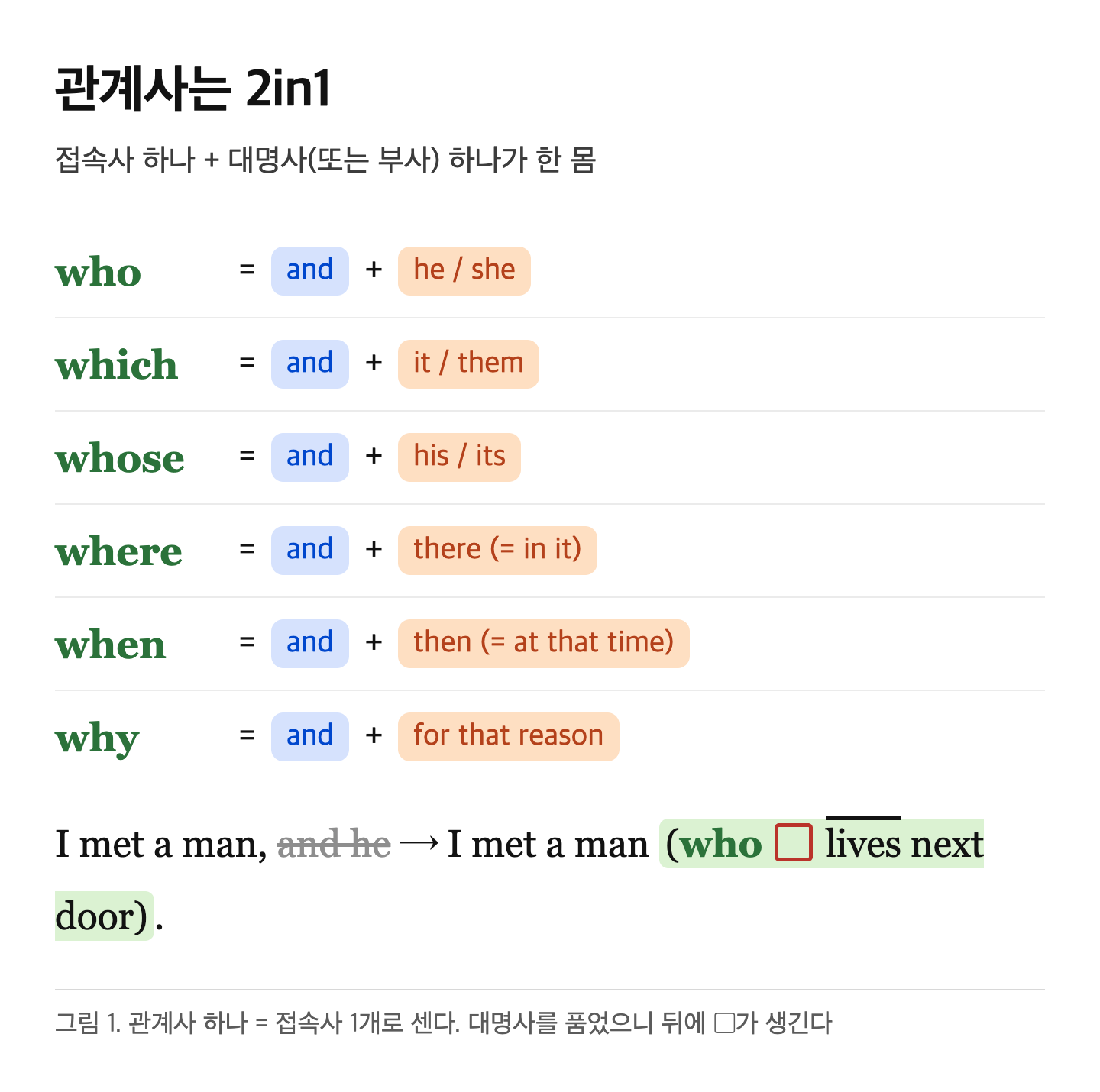
준기 그래서 관계사를 접속사 하나로 세는 거군요.
선생 그게 이번 강의 열쇠야. 관계사 안에 대명사가 이미 들어 있으니까, 관계사 뒤에는 그 대명사 자리가 비어. 그게 ▢야.
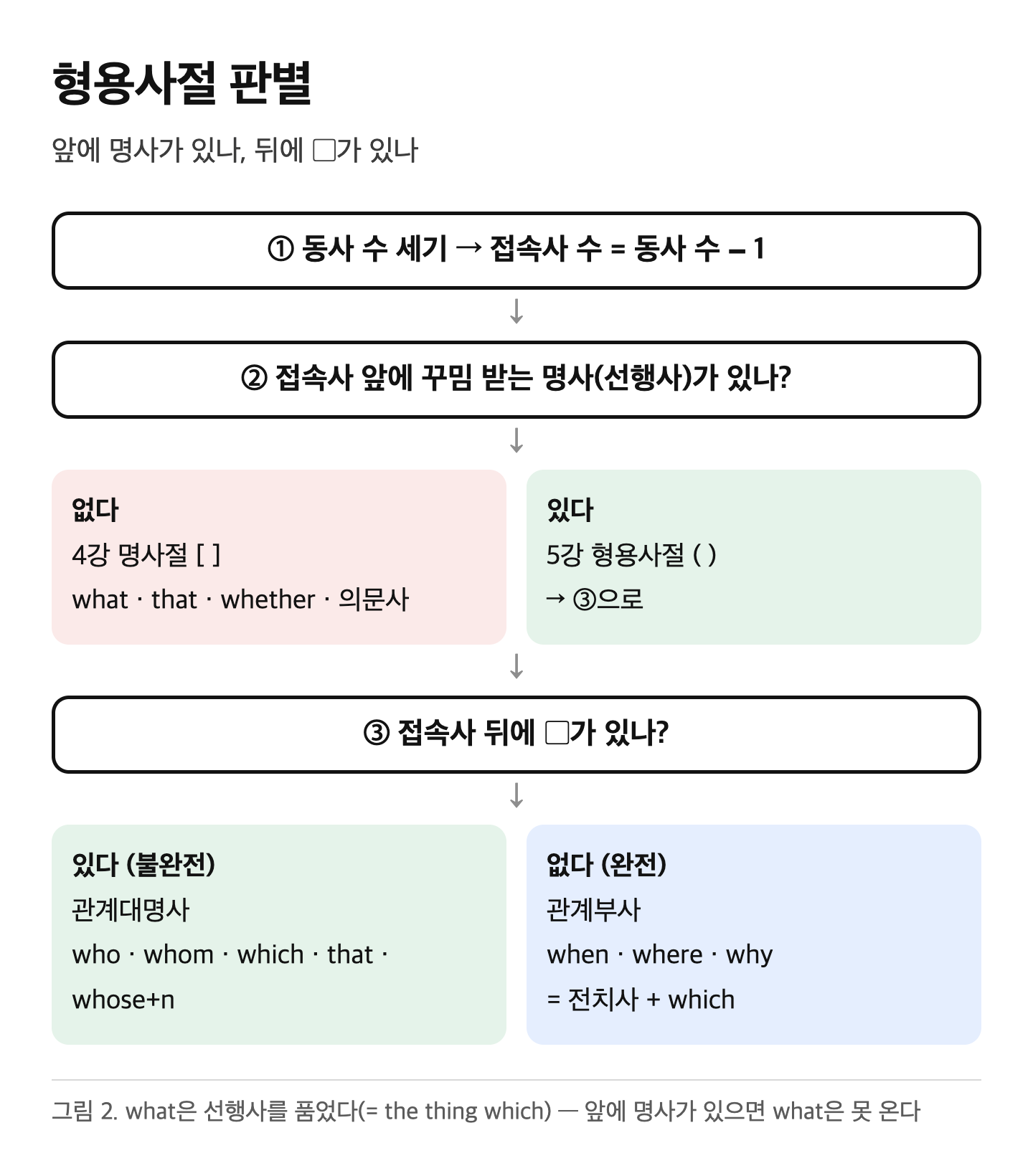
0-2 판별 — 앞에 명사, 뒤에 ▢
선생 4강에서 접속사 뒤를 봤지? 이번에도 같아. 순서는 이래.
1. 접속사 앞에 꾸밈 받을 명사(선행사)가 있나? 있으면 ( )
2. 뒤가 불완전(▢)이면 관계대명사, 완전이면 관계부사
준기 what은요? 4강에서 what 뒤도 불완전이었잖아요.
선생 what은 선행사를 안에 먹고 있어. what = the thing which. 그래서 앞에 명사가 없어. 명사가 있으면 which·that, 없으면 what.
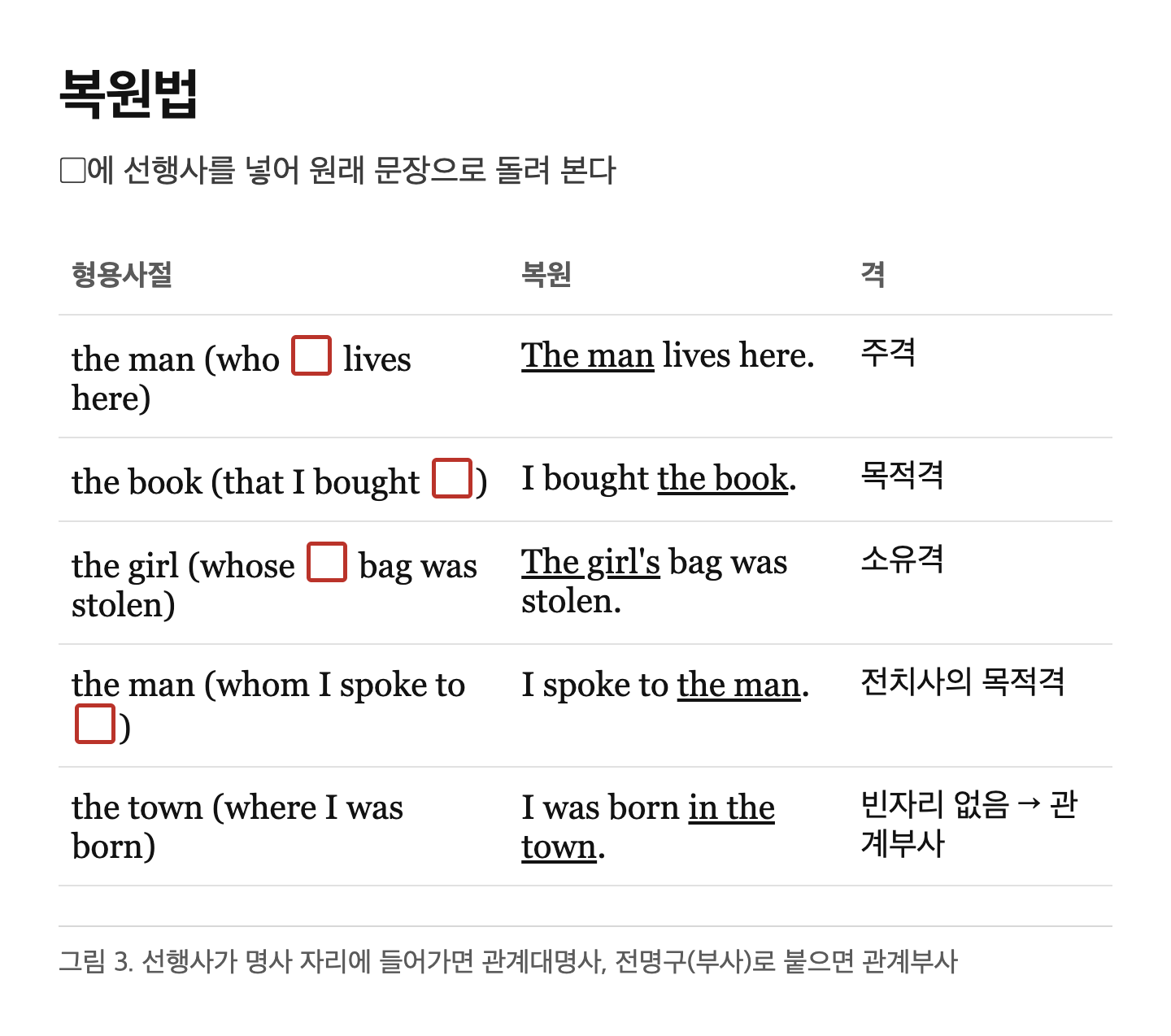
0-3 복원법 — ▢에 선행사를 넣는다
준기 ▢가 진짜 비었는지 어떻게 확신해요?
선생 선행사를 ▢에 다시 넣어 봐. 문장이 원래대로 돌아오면 맞는 거야.
- the book (that I bought ▢) → I bought the book. 목적어가 비었다 → 목적격
- the man (who ▢ lives next door) → The man lives next door. 주어가 비었다 → 주격
- the girl (whose ▢ bag was stolen) → The girl's bag was stolen. 소유격이 비었다 → whose
- the town (where I was born) → I was born in the town. 빈 곳이 없다 → 관계부사
준기 4강에서 배운 형식별 빈자리를 여기서도 쓰겠네요.
선생 그대로 써. ▢ v x(주어 빔), s v ▢(목적어 빔), s v n ▢(4형식 직접목적어 빔), s v x 전▢(전치사 목적어 빔), s v x to v ▢(to v의 목적어 빔).
0-4 관계대명사 — 격과 that
선생 선행사가 사람이면 who, 사물이면 which, 둘 다 that.
- 주격: the man (who ▢ called me) / the car (which ▢ broke down)
- 목적격: the man (whom I met ▢) / the car (which I bought ▢)
- 소유격: the man (whose son is a doctor) — whose 뒤에 명사가 붙는다
준기 whose 뒤는 완전해 보이는데요? whose son is a doctor.
선생 함정이야. whose가 the man's 자리를 먹었어. son is a doctor만 보면 완전 같지만, 원래 the man's son is a doctor에서 's 자리가 빈 거야. whose + 명사를 한 덩어리로 보고 그 뒤가 불완전한지를 봐.
0-5 관계부사 — when·where·why
선생 선행사가 시간이면 when, 장소면 where, 이유면 why. 뒤는 완전.
- the day (when we first met) — 그날에 우리가 처음 만났다
- the place (where I lost my key) — 거기서 열쇠를 잃어버렸다
- the reason (why she left) — 그 이유로 그녀가 떠났다
준기 how는요?
선생 the way how는 안 써. the way 아니면 how, 둘 중 하나만. how는 4강에서 명사절로 이미 했지.
0-6 전치사 + 관계대명사 — 전치사는 어디서 왔나
선생 이번 강의 깊은 곳이야. This is the house (in which I live).
준기 in은 어디서 온 거예요?
선생 복원해 봐. I live in the house. live는 1형식이라 the house가 바로 못 붙고 in이 필요하지. 그 in the house를 통째로 앞으로 끌어온 게 in which야.
준기 그럼 in which = where?
선생 맞아. in which가 in the house(부사구)를 대신하니까 관계부사와 같은 일을 해. 그래서 전치사 + which 뒤는 완전해.
전치사 + 관계대명사 = 관계부사 → 뒤는 완전
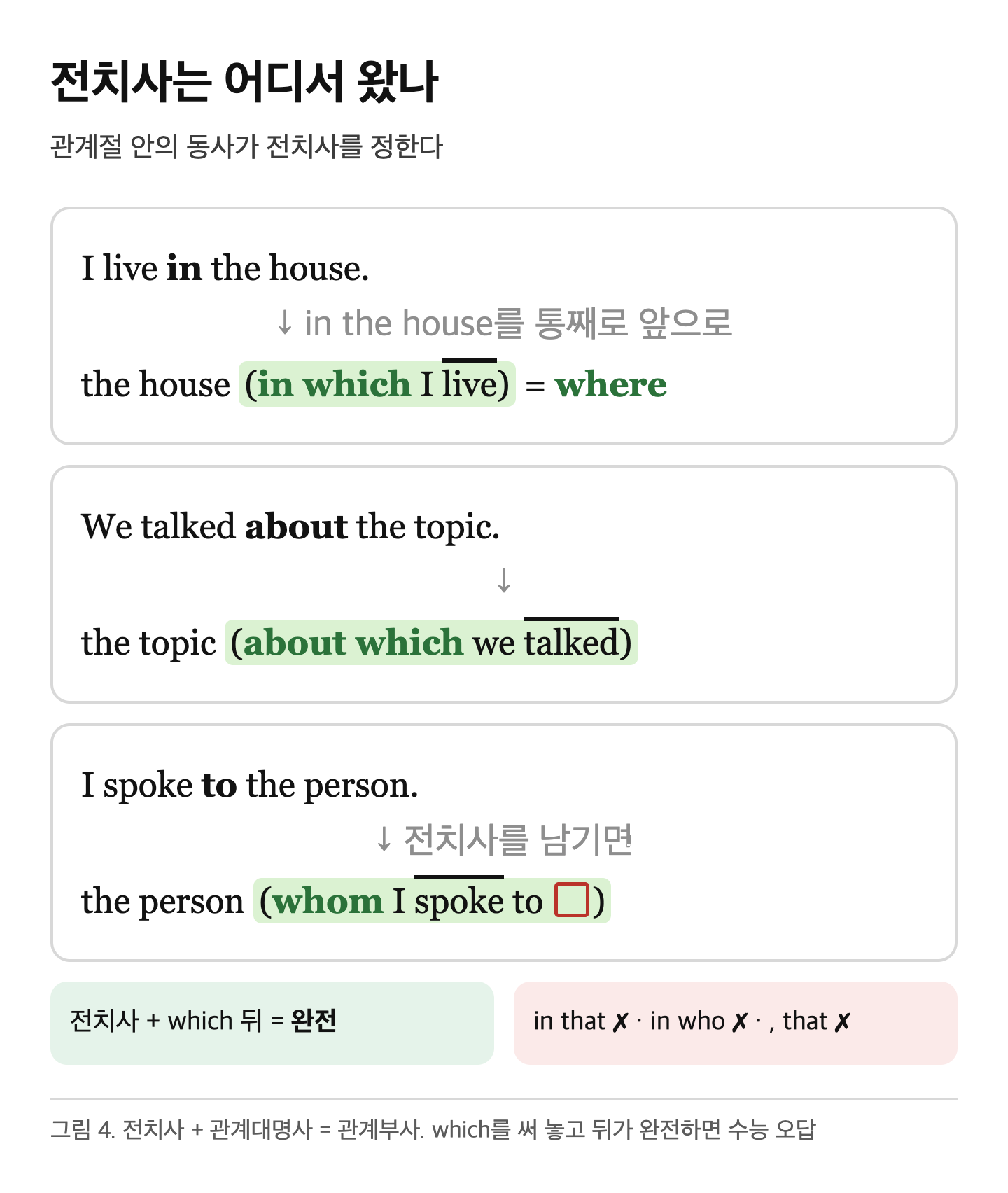
선생 전치사는 뒤에 남겨 둘 수도 있어. the person (whom I spoke to ▢). 이때는 to 뒤가 비었으니 불완전.
준기 그럼 똑같은 뜻인데 하나는 완전, 하나는 불완전이네요.
선생 전치사가 어디 있느냐에 따라 달라. 전치사를 앞으로 데려오면 완전, 뒤에 두면 s v x 전▢ 불완전.
준기 전치사 뒤에 that은요?
선생 못 써. in that, about that은 관계사로 안 돼. 전치사 + who도 안 되고 whom이야.
준기 수능에서는요?
선생 which를 고르게 해 놓고 뒤가 완전한 경우가 단골이야. a closed world (which we are absolutely sure …)처럼. 뒤가 완전하면 which가 아니라 in which나 where가 와야 해. 실전 1·2·3·5번이 다 이거야.
0-7 생략 — 동사는 두 개인데 접속사가 안 보일 때
선생 4강에서 that 생략을 동사 세기로 찾았지? 관계사도 똑같아.
1. 목적격 관계대명사 생략: the book (▢ I bought ▢). 동사 2개, 접속사 0개 → 명사 바로 뒤에 s v가 오면 생략.
2. 주격 관계대명사 + be 생략: the man (who is) standing there → the man standing there. 2강의 분사 덩어리가 바로 이거야.
3. 관계부사·선행사 생략: the place (where) I met him / (the place) where I met him. 선행사가 빠지면 4강의 명사절처럼 보여.
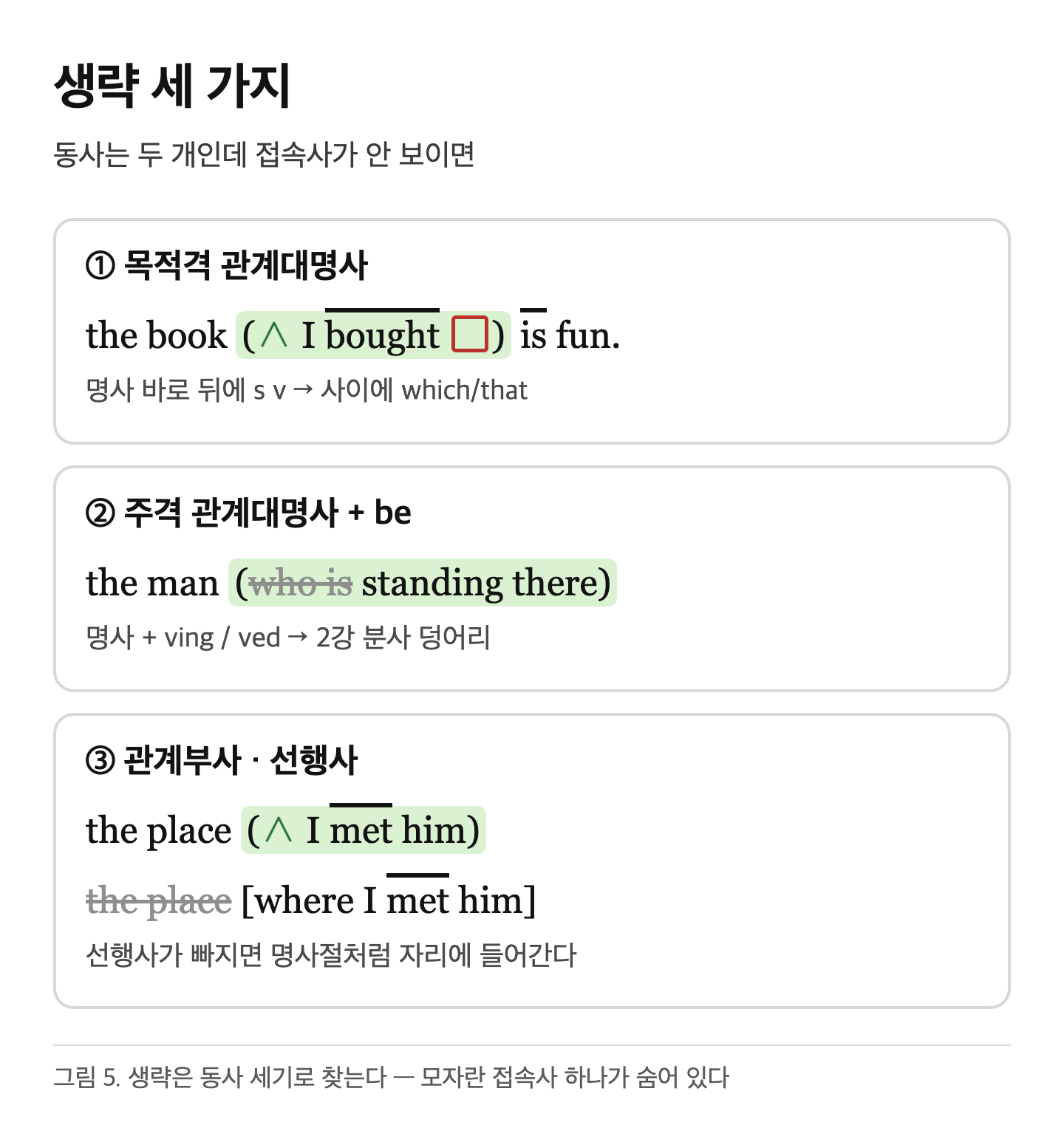
준기 명사 뒤에 바로 주어가 나오면 생략을 의심하면 되겠네요.
선생 the harsh conditions its parents experienced. conditions 뒤에 its parents가 바로 왔지? 동사 2개(…, experienced), 접속사가 하나 모자라. 그 사이에 which가 숨었어.
0-8 계속적 용법 — 콤마 뒤의 which
선생 콤마를 찍고 which를 쓰면 앞에서부터 '그런데 그것은'으로 이어 읽어.
- He bought a car, which broke down the next day. 그는 차를 샀는데, 그것이 다음 날 고장 났다.
준기 콤마 뒤에 that은요?
선생 안 돼. , that은 관계사로 못 써. 수능 어법 단골이야.
선생 , which는 앞 절 전체도 받아. He passed the test, which surprised me. 놀라게 한 건 '그가 합격한 일' 전체야. 그래서 동사가 단수(surprised, was, is)로 와.
선생 수량 표현과도 붙어. I have three brothers, all of whom are tall. some of whom, most of which, both of which, much of which.
0-9 대명사냐 관계사냐 — 접속사가 있느냐
준기 그럼 of whom과 of them은 어떻게 구별해요?
선생 동사를 세. 그게 이번 강의 핵심 어법이야.
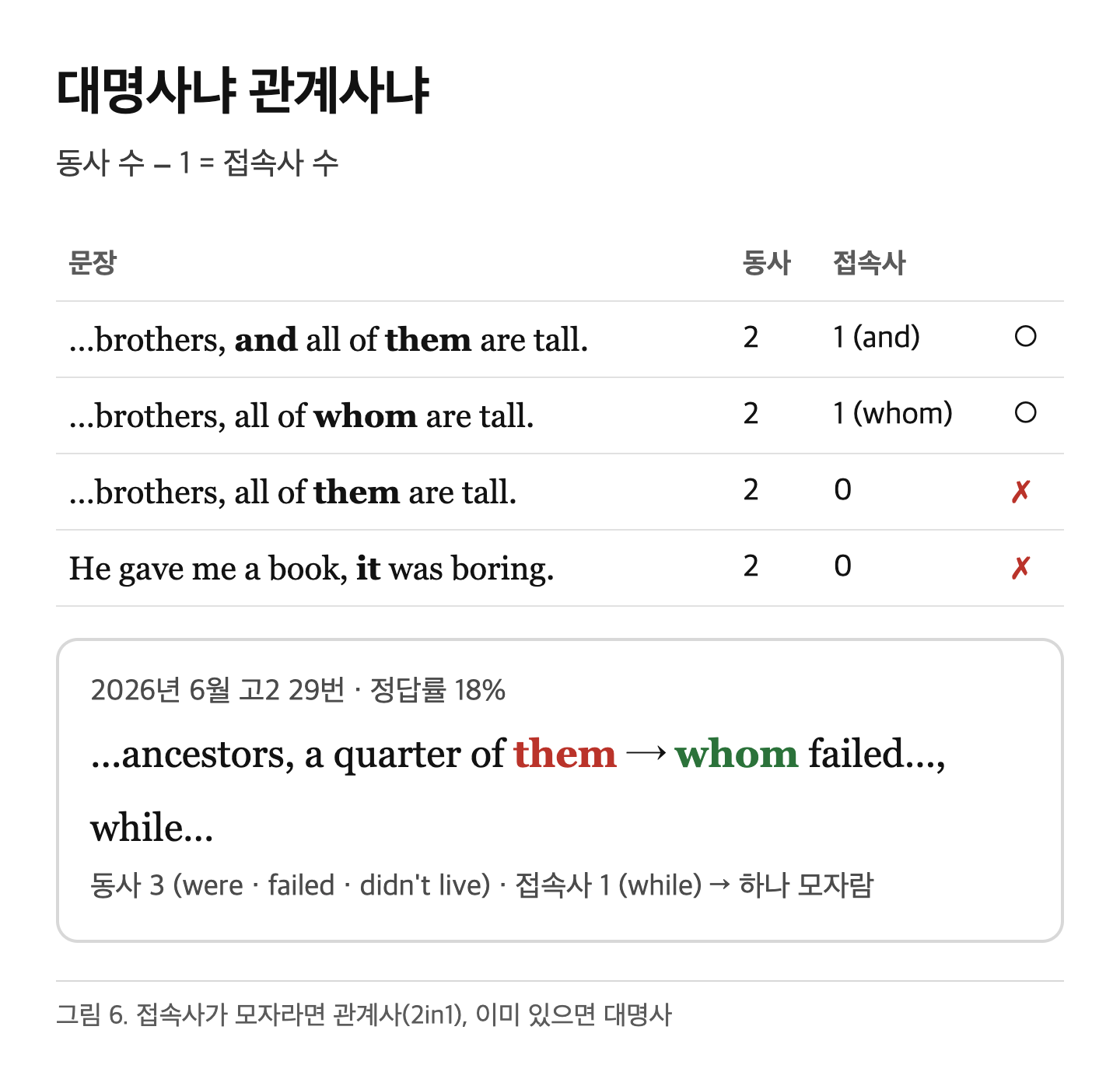
- I have three brothers, and all of them are tall. 동사 2(have, are), 접속사 1(and) → 대명사 them
- I have three brothers, all of whom are tall. 동사 2, 접속사 0? 아니야, whom이 접속사 1을 품고 있지 → 관계사
- I have three brothers, all of them are tall. 동사 2, 접속사 0 → 틀림. 접속사가 하나 모자라
준기 it과 which도 같아요?
선생 똑같아. He gave me a book, it was boring. 동사 2, 접속사 0 → 틀림. which로 바꾸든가 and it으로.
접속사가 모자라면 관계사, 접속사가 이미 있으면 대명사.
0-10 심화 — 떨어진 선행사, 삽입절, 이중 수식
선생 선행사가 바로 앞에 있지 않을 때가 있어.
- A man came in (who looked tired). 동사 came in이 끼어들었어.
- the key to the doors (that is on the table). is가 단수니 선행사는 doors가 아니라 key.
준기 수일치로 선행사를 찾는 거네요.
선생 맞아. 관계절 안 동사의 수는 선행사가 정해. 바로 앞 명사가 아닐 수도 있으니 수를 보고 거꾸로 찾아.
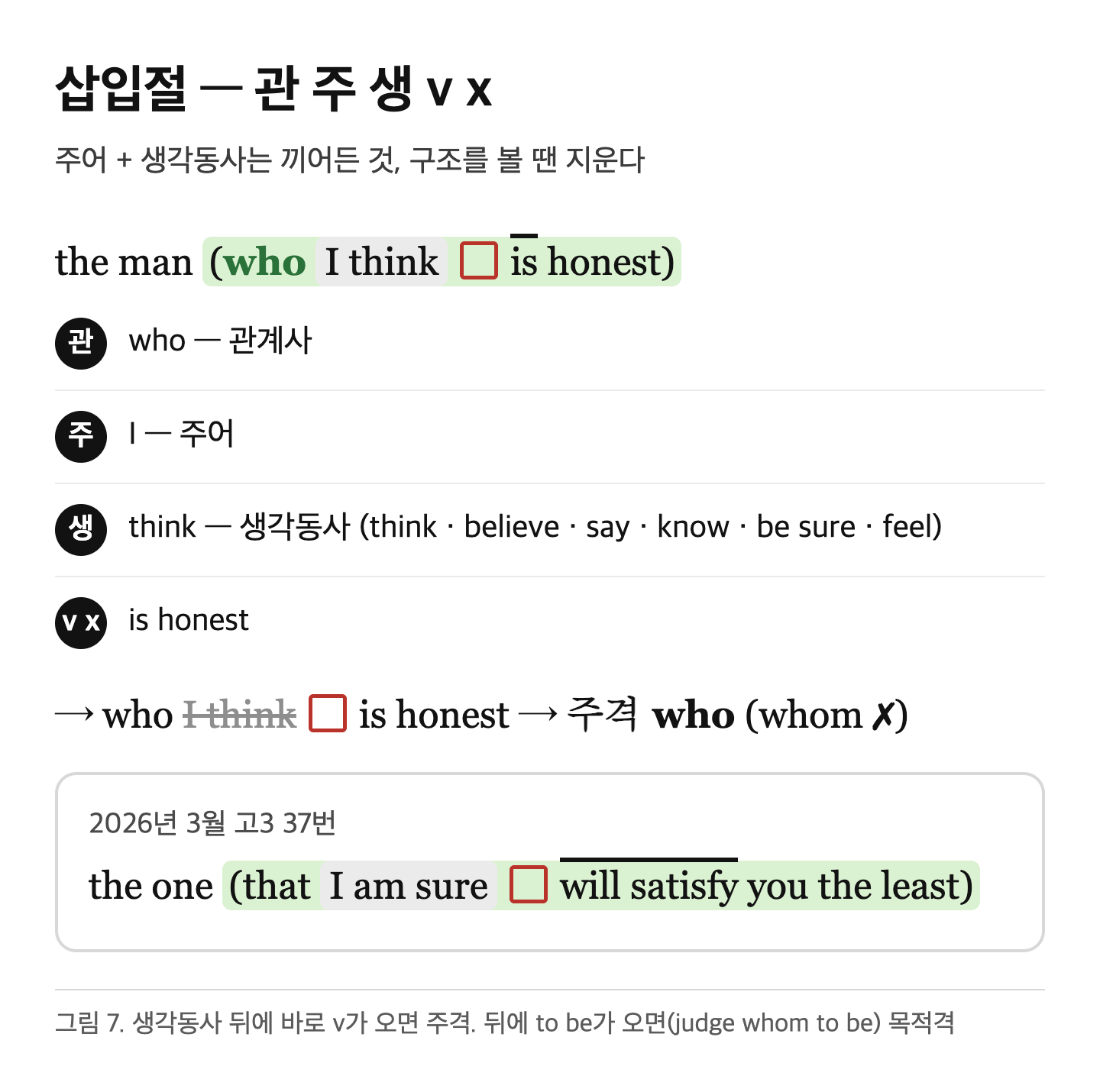
선생 이제 삽입절. the man (who I think is honest).
준기 동사가 think, is… 거기에 앞 문장 동사까지 세면 복잡해요.
선생 공식으로 외워. 관 주 생 v x.
- 관 = who (관계사)
- 주 생 = I think (주어 + 생각동사: think, believe, say, know, be sure, feel)
- v x = is honest
선생 주 생은 끼어든 거야. 구조를 볼 때는 지워. who is honest. 그럼 who 뒤에 주어가 비었으니 주격 who지.
준기 whom이 아니라 who!
선생 I think 뒤에 바로 is가 오니까 think의 목적어처럼 보여서 whom을 쓰고 싶어지지만, 지우면 who is야. 주격.
선생 마지막으로 이중 수식. 명사 하나를 관계절 두 개가 꾸밀 수 있어. the only person (I know) (who can speak Arabic). 두 괄호 모두 person을 꾸며.
0-11 that의 정체 셋
준기 that이 너무 많이 나와요.
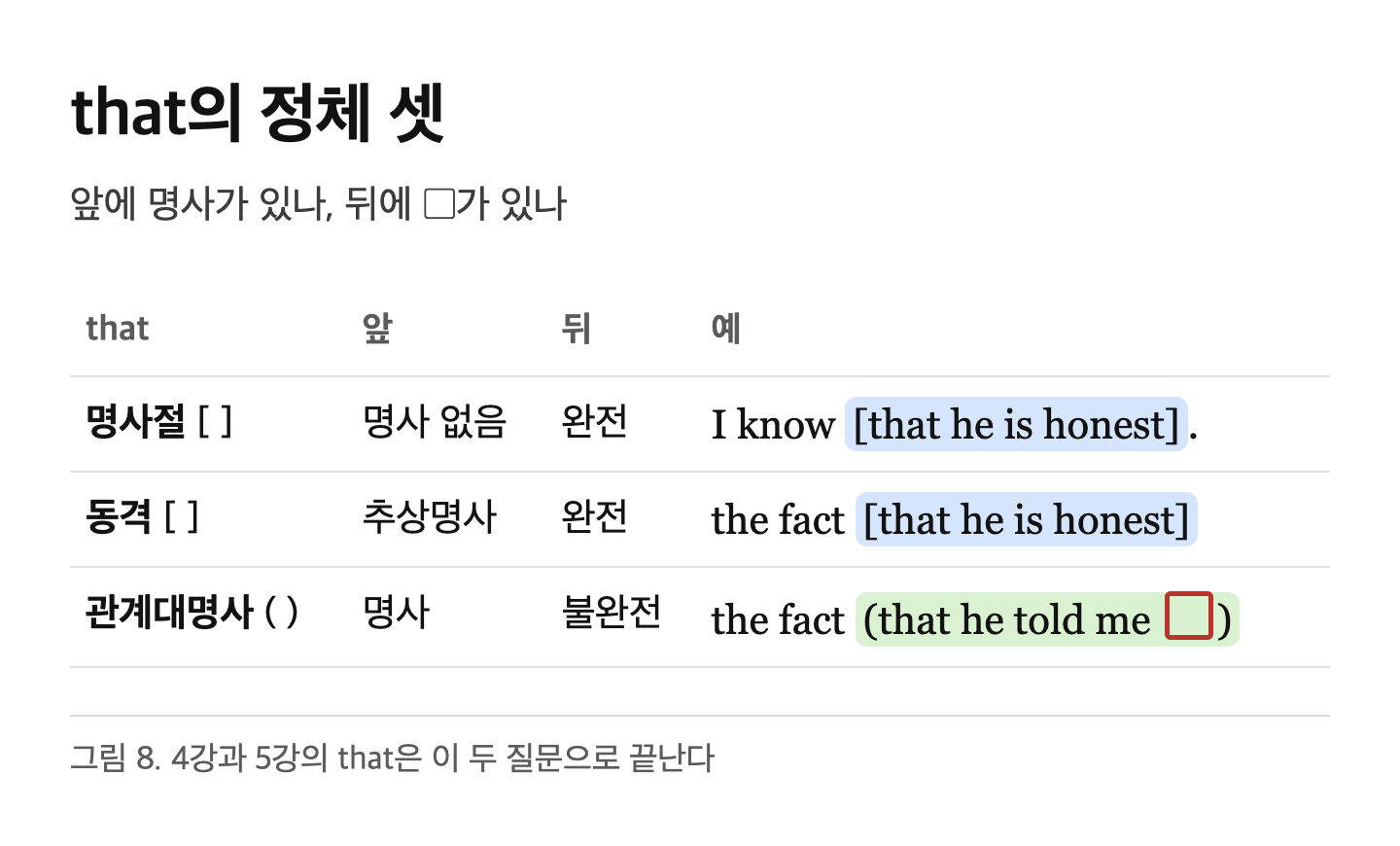
선생 정리해 줄게. 4강과 5강의 that은 셋이야.
- 명사절 that: I know [that he is honest]. 앞에 명사 없음, 뒤 완전
- 동격 that: the fact [that he is honest]. 앞에 추상명사, 뒤 완전
- 관계대명사 that: the fact (that he told me ▢). 앞에 명사, 뒤 불완전
준기 결국 앞과 뒤를 보면 되네요.
선생 앞에 명사가 있는가, 뒤에 ▢가 있는가. 이 두 질문이면 끝나.
0-12 해석 공식
선생 해석은 두 길이야.
- ( ) 제한적: '~하는'으로 앞 명사에 거꾸로 붙인다. the book (that I bought) 내가 산 책
- , which 계속적: 앞에서부터 '그런데 그것은'. 길면 끊고 이어 읽는다
- 관계부사·전치사+which: '~하는(시간·장소·이유)'. the town (where I was born) 내가 태어난 마을
준기 원리는 이번에도 하나네요.
선생 하나야. 동사를 세고, 앞에 명사를 보고, 뒤에 ▢를 본다. 관계사는 2in1. 이제 손에 익히자.
역사 한 장면who·which·where·when은 원래 모두 의문사였다. "누가?", "어느 것?", "어디?"를 묻던 말이 문장과 문장 사이로 들어가 '그 사람이', '그것이', '거기서'를 가리키게 되었다. 그래서 관계사와 의문사는 생김새가 같다. 4강의 의문사 명사절과 5강의 관계사는 같은 뿌리에서 갈라진 두 가지다.
1설명 — 쉬운 예문 30
형용사절에 ( )를 치고, 빈자리에 ▢를 찍고, 선행사와 해석을 쓴다. 홀수는 보기, 짝수는 직접 해 본다.
1-1. 관계대명사 10
1I have a friend (who ▢ lives in Busan). · 선행사 friend · 주격 · 나는 부산에 사는 친구가 있다.
2The cake which my mom made was delicious.
3This is the girl (whose brother ▢ is a singer). · 선행사 girl · 소유격 · 이 아이가 오빠가 가수인 소녀다.
4Anyone who wants to join the club can sign up here.
5The movie (that we watched ▢ last night) was boring. · 선행사 movie · 목적격 · 어젯밤 우리가 본 영화는 지루했다.
6The man whom I met at the party was a doctor.
7He is the student (who I think ▢ is the smartest). · 삽입절 관 주 생 v x · 주격 · 그는 내가 생각하기에 가장 똑똑한 학생이다.
8The house whose roof is red belongs to my uncle.
9The boy (I was talking to ▢) is my cousin. · 목적격 생략 · s v x 전▢ · 내가 이야기하던 소년은 내 사촌이다.
10The keys to the car that is parked outside are mine.
실수 노트10번에서 that절의 동사 is는 단수, 문장의 동사 are는 복수다. is parked의 주인은 car, are의 주인은 keys. 관계절 안의 동사와 문장의 동사를 헷갈리면 수일치가 무너진다.
1-2. 관계부사 · 전치사 + 관계대명사 10
11I remember the day (when I first met her). · 선행사 day · 관계부사, 뒤 완전 · 나는 그녀를 처음 만난 날을 기억한다.
12This is the restaurant where we had dinner last week.
13That is the reason (why he quit his job). · 선행사 reason · 뒤 완전 · 그것이 그가 일을 그만둔 이유다.
14The town in which I grew up has changed a lot.
15This is the topic (about which we talked). · we talked about the topic · 전치사+which, 뒤 완전 · 이것이 우리가 이야기한 주제다.
16The chair on which she sat was broken.
17The woman (to whom I sent the letter) is my teacher. · I sent the letter to the woman · 뒤 완전 · 내가 편지를 보낸 여자는 우리 선생님이다.
18The woman whom I sent the letter to is my teacher.
19I'll never forget the summer (we spent ▢ in Jeju). · 목적격 생략(spent의 목적어 빔, 관계부사 아님) · 나는 우리가 제주에서 보낸 여름을 절대 잊지 못할 것이다.
20This is how she solved the problem.
실수 노트19번 the summer 뒤를 when으로 바꾸면 틀린다. we spent ▢ in Jeju는 spent의 목적어가 비었으니 불완전, 관계대명사 that·which 자리다. 시간 명사라고 무조건 when이 아니다. ▢가 정한다.
1-3. 생략 · 계속적 용법 · 대명사 구별 10
21The girl (▢ dancing on the stage) is my sister. · 주격+be(who is) 생략, 2강 분사 · 무대에서 춤추는 소녀는 내 여동생이다.
22The letter written in French was hard to read.
23She lent me a book, (which ▢ was very interesting). · 계속적 · 그녀가 나에게 책을 빌려주었는데, 그것은 매우 재미있었다.
24He failed the exam, which surprised everyone.
25I have two sisters, (both of whom ▢ are nurses). · 수량 + of whom · 나는 언니가 둘 있는데, 둘 다 간호사다.
26I have two sisters, and both of them are nurses.
27This is the place (▢ I lost my wallet). · 관계부사 where 생략 · 여기가 내가 지갑을 잃어버린 곳이다.
28Home is where the heart is.
29The news (that she told me ▢) was shocking. · 관계대명사 that(뒤 불완전) · 그녀가 나에게 말해 준 소식은 충격적이었다.
30The news that she won the prize was shocking.
실수 노트25와 26은 뜻이 같지만, 접속사 수가 다르다. 25는 whom이 접속사를 품었고(2in1), 26은 and가 접속사다. and도 없이 both of them are nurses라고 쓰면 동사 2, 접속사 0으로 틀린다.
1.5미니 드릴 — 대명사냐 관계사냐 20
동사에 윗줄을 긋고, 동사 수 − 1 = 접속사 수로 맞는 것을 고른다.
D01I bought a new phone, (it / which) was very expensive.
D02I bought a new phone, and (it / which) was very expensive.
D03He has many friends, most of (them / whom) live abroad.
D04He has many friends, but most of (them / whom) live abroad.
D05The book has ten chapters, each of (them / which) ends with a quiz.
D06She told me a story, (it / which) made me cry.
D07There were thirty students, half of (them / whom) were absent.
D08There were thirty students. Half of (them / whom) were absent.
D09We visited Rome, (there / where) we saw the Colosseum.
D10We visited Rome, and (there / where) we saw the Colosseum.
D11He invited ten people, none of (them / whom) came.
D12The company makes cars, many of (them / which) are sold in Europe.
D13I met a man (who / whom) I thought was a famous actor.
D14I met a man (who / whom) I thought a famous actor.
D15The scientist (who / whose) theory changed the world died poor.
D16The plan was rejected, (that / which) disappointed the team.
D17He lives in a house (which / in which) has a big garden.
D18He lives in a house (which / in which) there is a big garden.
D19Look at the cats, all of (them / which) are white.
D20The players, (most of them / most of whom) were tired, kept running.
2연습 — 기출 문장 60
동사에 윗줄을 긋고, 형용사절을 ( )로 묶고, 빈자리에 ▢를 찍고, 선행사와 해석을 쓴다. 쉬운 문장부터 어려운 문장 순서다. 생략된 관계사, 떨어진 선행사, 명사절과 섞인 문장도 들어 있다.
01As a result, we are unable to fulfill the order that you've requested. 2603-18
02Science is the study of things that can be observed or measured in our material reality. 2603-39
03I believe your hotel pillows were the reason that I could sleep so well. 2613-18
04Chuck Jones was an influential director and artist whose work shaped animated films and cartoon production. 2693-26
05Otto Loewi was a pharmacologist whose discoveries greatly advanced the study of chemical communication between nerve cells. 2603-26
06He enrolled in the Rensselaer Scientific School, where he earned a degree in 1829. 2633-26
07His career reached a major turning point in 1837, when he was appointed Michigan's first State Geologist. 2633-26
08He directed the famous cartoon film How the Grinch Stole Christmas, which is still enjoyed by many people today. 2693-26
09The percentage of people who preferred Ebooks was the highest in the 18-29 age group, followed by the 30-44 age group. 2603-25
10In such cases, those who expect "great discoveries" will be disappointed. 2633-21
11His warm welcome helped Andy slowly explain his emotions and the guilt that kept him from facing his teammates. 2613-4345
12After Germany invaded Austria in 1938, Loewi was forced to leave Austria, where he was living at the time. 2603-26
13For using social networks to share pictures and updates, the percentage of Gen X was 50%, which was the highest among the three generations. 2633-25
14It had been more than ten years since she had last visited the area where she had grown up. 2513-19
15This posed a challenge to the selection committee, who thought it almost impossible to choose between the two equally impressive candidates. 2533-4345
16The environment in which a plant lives is inseparable from the plant itself. 2613-23
17Yet the factor that many don't consider is preparedness. 2613-20
18Every salmon river has its own unique set of challenges to which fish must adapt. 2693-37
19Social norms are the means by which social cohesion is achieved. 2603-40
20Although individuals differ considerably in their belief systems, those who objectify and test their own beliefs tend to think more critically than those who do not. 2613-29
21At the base of the status hierarchy among performers are cover bands, which are often accorded little critical artistic weight. 2603-30
22It would be nice to say that sleep is nothing more than the time when a body rests, but that wouldn't be quite right either. 2613-38
23It is probably also the reason why being tickled by someone else is more effective at producing an emotional reaction than trying to tickle yourself. 2693-32
24Conversely, the chatbot can also analyze conversations that went well, where users expressed satisfaction or gratitude for the provided solutions. 2603-32
25If you listen to someone who is not clear, who cannot stay on the topic, or who offers too much or too little information, you will quickly lose interest in the conversation. 2513-32
26These buildings were part of a rich and diverse culture, much of which has been lost. 2593-39
27Most Europeans and North Americans are disgusted by the prospect of eating insects, which is odd, since they consume prawns (which are broadly similar, being segmented, and with an external skeleton). 2613-36
28It recognizes that issues are complicated or nuanced, which increases receptiveness. 2533-20
29We could also increase the control resistance, which in turn will increase the force required for the operator to activate the control. 2613-31
30In many cases, performance is multidimensional, but compensation is only given to one aspect of performance, typically the one that is easiest to measure. 2693-36
31This process is supposedly driven by increased group size, which increases the number of social relationships an individual needs to maintain and monitor. 2603-4142
32And those changes can be passed down to their offspring, whose body will develop differently from the start, and be better able to handle the harsh conditions its parents experienced. 2613-23
33Unfortunately, the only answer I can give you is the one that I am sure will satisfy you the least, but let me say it anyway: the Universe expands into nothingness. 2633-37
34The rush of motivation that energizes you at the start of a new day, the focus that allows you to solve complex problems, and the curiosity that fuels ambition are all orchestrated by dopamine. 2693-23
35These words, spoken with much authority to senior fine arts majors, are the kind that those who create art are unable to ignore. 2633-31
36This is exactly the dichotomy that Merleau-Ponty's account of perception is trying to free us from: are we "seeing" objects or "constituting" them? 2603-21
37Nonetheless, these are bad answers, and they are bad precisely because they do not help me achieve the goal ─ leaving the house, opening a locked door ─ to which keylessness constituted an obstacle. 2633-22
38There are things which do not and cannot figure in the mirror ─ in the case of Tolstoy, certain contradictions in society of which he could not be conscious. 2633-4142
39Even so, the mirror makes us aware of these absences, which thus become faintly present. 2633-4142
40Not so, however, for the groundskeeper of a sports stadium, where the constituent grasses and their stages of growth really do matter. 2633-30
41For monasteries were intended to function as places set apart from the world, in which monks devoted their lives to a permanent rhythm of religious observance, prayer and study. 2593-24
42We are able to learn all the things we need to know in each of the many different environments in which we live only because we acquire information from others. 2513-29
43Places whose identity seems inaccessible, confusing or contradictory do not present themselves as destinations. 2503-23
44These cultural values have come to be seen as a place's identity, the possession of which is key to the important task of attracting visitors. 2503-23
45Therefore, the key to the ability of a population to survive by adaptation lies in the rapidity with which the next generation, the more resistant generation, is produced by the survivors of this generation. 2503-31
46A telephone call, which provides for audio cues and immediate feedback, is potentially richer than an email, which provides only textual cues and no immediate feedback. 2593-4142
47Males construct a bower; its function is to provide an arena in which males display to females standing in an avenue that leads up to the bower. 2593-31
48In 1904, he moved to Paris, where he was deeply affected by the expressive use of color that distinguished the paintings of Henri Matisse and Robert Delaunay. 2533-26
49Since the 1950s or '60s, theatrical designing moved toward a concept that we call selective visibility, which simply refers to revealing to an audience only what needs to be seen. 2693-40
50Instead, it offers a kind of glue, which helps unite linguistic elements in a larger semiotic expression, which, as a whole, shares important characteristics with the represented objects. 2633-38
51To acquire expert knowledge, one needs to become a member of the relevant group of knowledge bearers, for which I will use the term "epistemic communities." 2633-39
52Innovation provides one way of getting out of the competition, which is to say situations in which activities are not very profitable. 2613-39
53Individuals have no sensory receptors for these attributes, which refer to distal entities that have to be inferred from more proximal cues, and sometimes have no objective existence at all. 2603-36
54Currently, thousands of such projects have been set up all over the world, whereby volunteers help out in a number of research areas, including biodiversity, air quality, astronomy, and environmental issues. 2693-38
55Some research has explored specific technologies and the extent to which their characteristics lead to a feeling of social presence. 2593-4142
56Think for a moment of the pantheon of strangers we have in our heads that we put our social attention on ─ from athletes we root for or jeer, to celebrities, to people whose struggle we encounter in the news. 2503-34
57They provide a solid form or structure that enables the artist to make use of 'the gifts of chance' (to use Leth's expression), and in which a part of the world can be exhibited in a non-chaotic manner. 2533-34
58There is, in fact, no human society on the face of the earth which grants to any individual the right to learn anything he chooses. 2613-33
59This ability is possibly the simplest cognitive function that just separates us from animals, which would make music the decisive evolutionary step of the Homo sapiens. 2603-4142
60Let there be no doubt: the eager need for novelty, so characteristic of the escalating modernist auction, involves the idea that a musical act is a thing, in which case, music is no more than technique, technique alone. 2633-21
3실전 — 수능·모의고사 어법 6문항
관계사가 정답인 문항만 골랐다. 정답률이 높은 것부터 낮은 것 순서다. 동사를 세고, 앞에 명사가 있는지, 뒤에 ▢가 있는지 본 다음, 접속사가 모자라지 않은지 확인한다.
실전 1. 다음 글의 밑줄 친 부분 중, 어법상 틀린 것은? 2603-29 · 정답률 78% · 2026년 6월 고3
Deduction makes us feel safe: If and when we know all the elements of the problem situation and how they hang together, then we can ① confidently deduce the outcome. This is rationality at its most unassailable. In professional practice, this type of thinking expresses itself in the belief ② that we can produce "logical" strategies and blueprints, or the claim to base ourselves on "best practices" and "evidence-based interventions." But this gold standard of pure logic can only be achieved in a closed world, ③ which we are absolutely sure we know all the elements of the problem situation and completely understand all the relationships at play beforehand. In the real world, this never happens — and when it ④ does, we are talking about quite uninteresting, mechanical, routine reasoning. In practice, all problems are messy. Yet it is tempting ⑤ to claim that we have used deduction in dealing with a problem; this claim to pure rationality is so strong that we don't even have to defend the result. It is "logical," after all.
실전 2. 다음 글의 밑줄 친 부분 중, 어법상 틀린 것은? 2633-29 · 정답률 65% · 2026년 3월 고3
Darwin understood that since inheritance is conservative, it is in the nature of the organism to impose itself on the surroundings, ① producing many highly similar but variable offspring regardless of the nature of the conditions. He further recognized that these fundamental aspects of the nature of the organism ② imply reproductive overrun, with organisms routinely producing more offspring than there are resources to support them. The need to survive implies that the capacity for using necessary resources must complement the opportunity to use ③ them. But needs and opportunity do not perfectly match. Inheritance produces the capacities for exploiting the surroundings, but in a way that is indifferent to the surroundings. Offspring cannot anticipate the nature of the conditions ④ which they find themselves, much less alter themselves in ways that are suitable to any changes in those conditions. While it is true that organisms can express some amount of flexibility in their form and function in response to their immediate surroundings, these adjustments are ⑤ minor compared to the constraints of inheritance. As a result, not every living thing can live everywhere.
실전 3. 다음 글의 밑줄 친 부분 중, 어법상 틀린 것은? 2313-29 · 정답률 56% · 2023년 11월 고3 (2024학년도 수능)
A number of studies provide substantial evidence of an innate human disposition to respond differentially to social stimuli. From birth, infants will orient preferentially towards the human face and voice, ① seeming to know that such stimuli are particularly meaningful for them. Moreover, they register this connection actively, imitating a variety of facial gestures that are presented to them ― tongue protrusions, lip tightenings, mouth openings. They will even try to match gestures ② which they have some difficulty, experimenting with their own faces until they succeed. When they ③ do succeed, they show pleasure by a brightening of their eyes; when they fail, they show distress. In other words, they not only have an innate capacity for matching their own kinaesthetically experienced bodily movements with ④ those of others that are visually perceived; they have an innate drive to do so. That is, they seem to have an innate drive to imitate others whom they judge ⑤ to be 'like me'.
실전 4. 다음 글의 밑줄 친 부분 중, 어법상 틀린 것은? 1913-29 · 정답률 54% · 2019년 11월 고3 (2020학년도 수능)
Speculations about the meaning and purpose of prehistoric art ① rely heavily on analogies drawn with modern-day hunter-gatherer societies. Such primitive societies, ② as Steven Mithen emphasizes in The Prehistory of the Modern Mind, tend to view man and beast, animal and plant, organic and inorganic spheres, as participants in an integrated, animated totality. The dual expressions of this tendency are anthropomorphism (the practice of regarding animals as humans) and totemism (the practice of regarding humans as animals), both of ③ which spread through the visual art and the mythology of primitive cultures. Thus the natural world is conceptualized in terms of human social relations. When considered in this light, the visual preoccupation of early humans with the nonhuman creatures ④ inhabited their world becomes profoundly meaningful. Among hunter-gatherers, animals are not only good to eat, they are also good to think about, as Claude Lévi-Strauss has observed. In the practice of totemism, he has suggested, an unlettered humanity "broods upon ⑤ itself and its place in nature."
실전 5. 다음 글의 밑줄 친 부분 중, 어법상 틀린 것은? 1992-29 · 정답률 35% · 2019년 9월 고2
Not only are humans ① unique in the sense that they began to use an ever-widening tool set, we are also the only species on this planet that has constructed forms of complexity that use external energy sources. This was a fundamental new development, ② which there were no precedents in big history. This capacity may first have emerged between 1.5 and 0.5 million years ago, when humans began to control fire. From at least 50,000 years ago, some of the energy stored in air and water flows ③ was used for navigation and, much later, also for powering the first machines. Around 10,000 years ago, humans learned to cultivate plants and ④ tame animals and thus control these important matter and energy flows. Very soon, they also learned to use animal muscle power. About 250 years ago, fossil fuels began to be used on a large scale for powering machines of many different kinds, thereby ⑤ creating the virtually unlimited amounts of artificial complexity that we are familiar with today.
실전 6. 다음 글의 밑줄 친 부분 중, 어법상 틀린 것은? 2602-29 · 정답률 18% · 2026년 6월 고2
You might think of survival as a race ① in which a hurdle has to be jumped every year. The early hurdles were once very high, and many people fell before clearing the first few. Demographically, humankind was living close to a state of nature, and nature is extremely wasteful of life. From only a very small number of figs will even one of many seeds ② become a fig tree. Almost a quarter of baboons born in the wild die before they are a year old, which ③ is fairly typical for primates. Infant mortality rates for humans in premodern agricultural societies were similar to, and sometimes higher, than ④ those of apes. Things were little better for our huntergatherer ancestors, a quarter of ⑤ them failed to reach their first birthday, while another quarter didn't live long enough to reproduce just about everywhere until the nineteenth century. Had it been otherwise, the huge recent growth in human population would have occurred much earlier.
✓정답·해설
설명 짝수 정답
2. The cake (which my mom made ▢) was delicious. · 선행사 cake · 목적격 · 엄마가 만든 케이크는 맛있었다.
4. Anyone (who ▢ wants to join the club) can sign up here. · 선행사 anyone · 주격 · 동아리에 가입하고 싶은 사람은 누구나 여기서 신청할 수 있다.
6. The man (whom I met ▢ at the party) was a doctor. · 목적격 · 내가 파티에서 만난 남자는 의사였다.
8. The house (whose roof ▢ is red) belongs to my uncle. · 소유격(the house's roof) · 지붕이 빨간 집은 삼촌 것이다.
10. The keys to the car (that ▢ is parked outside) are mine. · 선행사 car(is 단수) · 밖에 주차된 차의 열쇠는 내 것이다.
12. This is the restaurant (where we had dinner last week). · 관계부사, 뒤 완전 · 이곳이 우리가 지난주에 저녁을 먹은 식당이다.
14. The town (in which I grew up) has changed a lot. · I grew up in the town · 내가 자란 마을은 많이 변했다.
16. The chair (on which she sat) was broken. · she sat on the chair · 그녀가 앉았던 의자는 부서져 있었다.
18. The woman (whom I sent the letter to ▢) is my teacher. · 전치사를 뒤에 남김, s v x 전▢ · 17번과 같은 뜻.
20. This is [how she solved the problem]. · the way 생략, 명사절(4강) · 이것이 그녀가 그 문제를 푼 방법이다.
22. The letter (▢ written in French) was hard to read. · 주격+be(which was) 생략 · 프랑스어로 쓰인 편지는 읽기 어려웠다.
24. He failed the exam, (which surprised everyone). · 앞 절 전체 · 그가 시험에 떨어졌는데, 그 일이 모두를 놀라게 했다.
26. I have two sisters, and both of them are nurses. · 관계사 아님. and가 접속사, them은 대명사 · 25번과 같은 뜻.
28. Home is [where the heart is]. · 선행사(the place) 생략 → 명사절처럼 보어 자리 · 집은 마음이 있는 곳이다.
30. The news [that she won the prize] was shocking. · 동격 that(뒤 완전) · 그녀가 상을 탔다는 소식은 충격적이었다.
미니 드릴 정답
D01 which · 동사 2(bought, was), 접속사 0 → 관계사
D02 it · and가 접속사 → 대명사
D03 whom · 동사 2(has, live), 접속사 0 → 관계사
D04 them · but이 접속사
D05 which · 동사 2(has, ends), 접속사 0
D06 which · 동사 2(told, made), 접속사 0
D07 whom · 동사 2(were, were), 접속사 0
D08 them · 마침표로 문장이 둘. 각 문장에 동사 1
D09 where · 동사 2(visited, saw), 접속사 0 → 관계부사
D10 there · and가 접속사 → 부사
D11 whom · 동사 2(invited, came)
D12 which · 동사 2(makes, are sold)
D13 who · 관 주 생 v x — I thought를 지우면 who was a famous actor, 주격
D14 whom · I thought him a famous actor — 5형식 s v ▢ n, 목적격
D15 whose · 뒤에 theory(명사)가 붙고 the scientist's theory
D16 which · 앞 절 전체를 받는 계속적 용법. , that은 불가
D17 which · has의 주어가 빔(불완전) → 관계대명사
D18 in which · there is a big garden in the house — 뒤 완전
D19 which · 동사 2(look, are), 접속사 0
D20 most of whom · 동사 2(were, kept), 접속사 0
연습 60 정답
01 the order (that you've requested ▢) — 목적격
그 결과, 귀하께서 요청하신 주문을 처리해 드릴 수 없습니다.
02 things (that ▢ can be observed or measured in our material reality) — 주격
과학은 우리의 물질적 현실에서 관찰되거나 측정될 수 있는 것들에 대한 연구다.
03 the reason (that I could sleep so well) — that이 why 대신, 뒤 완전 · your hotel pillows 앞 that 생략(명사절)
저는 제가 그렇게 잘 잘 수 있었던 이유가 귀하의 호텔 베개였다고 생각합니다.
04 an influential director and artist (whose work ▢ shaped animated films and cartoon production) — 소유격
척 존스는 애니메이션 영화와 만화 제작에 큰 영향을 준 작품을 남긴 영향력 있는 감독이자 예술가였다.
05 a pharmacologist (whose discoveries ▢ greatly advanced …) — 소유격
오토 뢰비는 그의 발견이 신경 세포 사이의 화학적 의사소통 연구를 크게 발전시킨 약리학자였다.
06 the Rensselaer Scientific School, (where he earned a degree in 1829) — 계속적 관계부사, 뒤 완전
그는 렌셀러 과학 학교에 입학했고, 그곳에서 1829년에 학위를 받았다.
07 1837, (when he was appointed Michigan's first State Geologist) — 계속적 관계부사
그의 경력은 1837년에 큰 전환점을 맞았는데, 그때 그는 미시간 주의 첫 주 지질학자로 임명되었다.
08 … How the Grinch Stole Christmas, (which ▢ is still enjoyed by many people today) — 계속적, 주격
그는 유명한 만화 영화 '그린치는 어떻게 크리스마스를 훔쳤나'를 감독했는데, 그 작품은 오늘날에도 많은 사람이 즐긴다.
09 people (who ▢ preferred Ebooks) — 주격 · 문장의 동사는 was(주어 The percentage)
전자책을 선호한 사람들의 비율은 18~29세 집단에서 가장 높았고, 30~44세 집단이 그 뒤를 이었다.
10 those (who ▢ expect "great discoveries") — 주격, those = people
그런 경우 '위대한 발견'을 기대하는 사람들은 실망할 것이다.
11 the guilt (that ▢ kept him from facing his teammates) — 주격
그의 따뜻한 환영 덕분에 Andy는 자신의 감정과 팀원들을 마주하지 못하게 했던 죄책감을 천천히 털어놓을 수 있었다.
12 Austria, (where he was living at the time) — 계속적 관계부사
1938년 독일이 오스트리아를 침공한 뒤 뢰비는 오스트리아를 떠나야 했는데, 그는 당시 그곳에 살고 있었다.
13 50%, (which ▢ was the highest among the three generations) — 계속적, 주격
사진과 소식을 공유하려고 소셜 네트워크를 쓰는 비율은 X세대가 50%였고, 이는 세 세대 중 가장 높았다.
14 the area (where she had grown up) — 관계부사, 뒤 완전
그녀가 자란 지역을 마지막으로 찾은 지 10년이 넘었다.
15 the selection committee, (who ▢ thought it almost impossible to choose …) — 계속적, 주격 · it 가목적어(4강)
이것은 선발 위원회에 어려움을 안겼고, 위원회는 똑같이 인상적인 두 후보 중 하나를 고르는 것이 거의 불가능하다고 생각했다.
16 The environment (in which a plant lives) — a plant lives in the environment, 뒤 완전
식물이 사는 환경은 식물 그 자체와 떼어 놓을 수 없다.
17 the factor (that many don't consider ▢) — 목적격
하지만 많은 사람이 고려하지 않는 요소는 준비성이다.
18 challenges (to which fish must adapt) — fish must adapt to challenges
모든 연어 강에는 물고기가 적응해야 하는 고유한 난관들이 있다.
19 the means (by which social cohesion is achieved) — social cohesion is achieved by the means
사회 규범은 사회적 결속이 이루어지는 수단이다.
20 those (who ▢ objectify and test their own beliefs) / those (who ▢ do not) — 주격 두 번 · do not = do not objectify and test
개인마다 신념 체계는 상당히 다르지만, 자기 신념을 객관화하고 검증하는 사람은 그렇지 않은 사람보다 더 비판적으로 사고하는 경향이 있다.
21 cover bands, (which ▢ are often accorded little critical artistic weight) — 계속적 · 장소 부사구 + are + 주어 도치
연주자들 사이 지위 서열의 맨 아래에는 커버 밴드가 있는데, 이들은 흔히 비평적·예술적 무게를 거의 인정받지 못한다.
22 the time (when a body rests) — 관계부사
잠이 몸이 쉬는 시간에 불과하다고 말하면 좋겠지만, 그것도 꼭 맞는 말은 아니다.
23 the reason (why being tickled by someone else is more effective …) — 관계부사, 뒤 완전(주어는 동명사 being tickled)
그것은 아마 다른 사람이 간지럽히는 것이 스스로 간지럽히는 것보다 감정 반응을 일으키는 데 더 효과적인 이유이기도 할 것이다.
24 conversations (that ▢ went well), (where users expressed satisfaction …) — 주격 + 계속적 관계부사(추상적 장소: 그런 대화에서)
반대로 챗봇은 잘 풀린 대화, 즉 사용자가 제공된 해결책에 만족이나 고마움을 표현한 대화도 분석할 수 있다.
25 someone (who ▢ is not clear), (who ▢ cannot stay on the topic), or (who ▢ offers …) — 한 선행사를 관계절 셋이 병렬로 꾸밈
말이 분명하지 않거나, 주제에서 벗어나거나, 정보를 너무 많이 또는 너무 적게 주는 사람의 말을 들으면 금세 대화에 흥미를 잃는다.
26 a rich and diverse culture, (much of which ▢ has been lost) — 수량 + of which · 동사 2(were, has been lost), 접속사 0 → which
이 건물들은 풍부하고 다양한 문화의 일부였는데, 그 문화의 많은 부분이 사라졌다.
27 …eating insects, (which ▢ is odd) — 앞 절 전체(단수 is) · prawns (which ▢ are broadly similar …) — 선행사 prawns(복수 are)
대부분의 유럽인과 북미인은 곤충을 먹는다는 생각에 혐오감을 느끼는데, 이는 이상한 일이다. 그들은 새우를 먹기 때문이다(새우는 마디가 있고 겉뼈대가 있어 곤충과 대체로 비슷하다).
28 , (which ▢ increases receptiveness) — 앞 절 전체(단수 increases)
그것은 문제가 복잡하거나 미묘하다는 것을 인정하는데, 그 점이 수용성을 높인다.
29 the control resistance, (which ▢ in turn will increase the force …) — 계속적 · the force (▢ required …) 주격+be 생략(2강)
조작 저항을 높일 수도 있는데, 그러면 이번에는 조작자가 장치를 작동하는 데 필요한 힘이 커진다.
30 the one (that ▢ is easiest to measure) — 주격, the one = the aspect
많은 경우 성과는 여러 차원으로 이루어지지만, 보상은 성과의 한 측면, 보통 가장 측정하기 쉬운 측면에만 주어진다.
31 increased group size, (which ▢ increases the number of social relationships) · social relationships (▢ an individual needs to maintain and monitor ▢) — 목적격 생략
이 과정은 집단 크기가 커지면서 일어난다고 여겨지는데, 집단이 커지면 한 개체가 유지하고 살펴야 할 사회적 관계의 수가 늘어난다.
32 their offspring, (whose body ▢ will develop differently … and be better able to handle …) · the harsh conditions (▢ its parents experienced ▢) — 소유격 + 목적격 생략
그리고 그 변화는 자손에게 물려질 수 있는데, 자손의 몸은 처음부터 다르게 발달하여 부모가 겪은 혹독한 조건을 더 잘 견딜 수 있게 된다.
33 the only answer (▢ I can give you ▢) — 목적격 생략 / the one (that [I am sure] ▢ will satisfy you the least) — 관 주 생 v x, 주격
안타깝게도 내가 줄 수 있는 유일한 답은 아마 당신을 가장 덜 만족시킬 답이겠지만, 그래도 말해 보겠다. 우주는 무(無) 속으로 팽창한다.
34 The rush of motivation (that ▢ energizes you …), the focus (that ▢ allows you …), and the curiosity (that ▢ fuels ambition) — 주어 셋이 각각 관계절을 달고, 문장의 동사는 are
새로운 하루를 시작할 때 힘을 주는 의욕의 분출, 복잡한 문제를 풀게 해 주는 집중력, 야망을 키우는 호기심은 모두 도파민이 조율한다.
35 the kind (that those (who ▢ create art) are unable to ignore ▢) — 관계절 안에 관계절(목적격 안에 주격)
미술 전공 4학년생들에게 권위 있게 건네진 이 말은 예술을 창작하는 사람이라면 무시할 수 없는 종류의 말이다.
36 the dichotomy (that Merleau-Ponty's account of perception is trying to free us from ▢) — s v x to v x 전▢
이것이 바로 메를로퐁티의 지각 이론이 우리를 벗어나게 하려는 이분법이다. 우리는 대상을 '보는' 것인가, '구성하는' 것인가?
37 the goal ─ leaving the house, opening a locked door ─ (to which keylessness constituted an obstacle) — 떨어진 선행사 goal · keylessness constituted an obstacle to the goal
그래도 이것들은 나쁜 답이며, 바로 열쇠가 없다는 사실이 장애가 되었던 목표, 즉 집을 나서거나 잠긴 문을 여는 일을 이루는 데 도움이 되지 않기 때문에 나쁘다.
38 things (which ▢ do not and cannot figure in the mirror) · certain contradictions in society (of which he could not be conscious) — he could not be conscious of the contradictions
거울에 나타나지 않고 나타날 수도 없는 것들이 있다. 톨스토이의 경우 그가 의식할 수 없었던 사회의 어떤 모순들이 그렇다.
39 these absences, (which ▢ thus become faintly present) — 계속적, 선행사 absences(복수 become)
그렇더라도 거울은 우리에게 이 부재를 깨닫게 하고, 그 부재는 그렇게 해서 희미하게나마 존재하게 된다.
40 a sports stadium, (where the constituent grasses and their stages of growth really do matter) — 계속적 관계부사 · 선행사는 the groundskeeper가 아니라 장소 stadium
하지만 스포츠 경기장 관리인에게는 그렇지 않다. 경기장에서는 잔디를 이루는 풀의 종류와 생장 단계가 정말 중요하기 때문이다.
41 places (▢ set apart from the world) — 주격+be 생략, (in which monks devoted their lives …) — 선행사 places · monks devoted their lives in the places
수도원은 세상과 떨어진 장소로 기능하도록 만들어졌으며, 그곳에서 수도사들은 종교 의식과 기도와 공부의 변함없는 리듬에 평생을 바쳤다.
42 all the things (▢ we need to know ▢) — 목적격 생략, s v to v ▢ · the many different environments (in which we live)
우리가 살아가는 여러 다른 환경 각각에서 알아야 할 모든 것을 배울 수 있는 것은 오로지 다른 사람에게서 정보를 얻기 때문이다.
43 Places (whose identity ▢ seems inaccessible, confusing or contradictory) — 소유격 · 문장의 동사는 do not present(복수 Places)
정체성이 다가가기 어렵거나 혼란스럽거나 모순되어 보이는 장소는 여행지로 다가오지 않는다.
44 a place's identity, (the possession of which ▢ is key to …) — 명사 + of which: the possession of the identity
이 문화적 가치들은 한 장소의 정체성으로 여겨지게 되었고, 그 정체성을 가지는 것이 방문객을 끌어들이는 중요한 일의 열쇠다.
45 the rapidity (with which the next generation … is produced by the survivors …) — the next generation is produced with rapidity · 콤마 사이는 동격 삽입
따라서 개체군이 적응을 통해 살아남을 수 있는 능력의 열쇠는, 다음 세대, 즉 더 강한 세대가 이번 세대의 생존자들에 의해 얼마나 빨리 생겨나느냐에 있다.
46 A telephone call, (which ▢ provides …), … an email, (which ▢ provides only textual cues …) — 계속적 두 번, 각각 단수 선행사
음성 단서와 즉각적인 피드백을 주는 전화 통화는 글자 단서만 있고 즉각적인 피드백이 없는 이메일보다 잠재적으로 더 풍부하다.
47 an arena (in which males display to females …) — males display in the arena · females (▢ standing in an avenue) — 주격+be 생략 · an avenue (that ▢ leads up to the bower) — 주격
수컷은 정자(bower)를 짓는다. 그 기능은 수컷이 정자로 이어지는 길에 서 있는 암컷에게 과시하는 무대를 마련하는 것이다.
48 Paris, (where he was deeply affected by the expressive use of color) · color (that ▢ distinguished the paintings …) — 선행사는 color가 아니라 the expressive use (of color)
1904년 그는 파리로 갔고, 그곳에서 앙리 마티스와 로베르 들로네의 그림을 돋보이게 한 표현적인 색채 사용에 깊은 영향을 받았다.
49 a concept (that we call ▢ selective visibility) — 5형식 s v ▢ n(4강 what they call him과 같은 구조) · , (which ▢ simply refers to …) · only [what ▢ needs to be seen] — 명사절(4강)
1950~60년대 이후 무대 디자인은 우리가 '선택적 가시성'이라고 부르는 개념으로 옮겨 갔는데, 이는 관객에게 보여야 할 것만 보여 주는 것을 말한다.
50 a kind of glue, (which ▢ helps unite …), (which, as a whole, ▢ shares …) — 두 번째 which의 선행사는 glue가 아니라 a larger semiotic expression
오히려 그것은 일종의 접착제를 제공하는데, 그 접착제는 언어 요소들을 더 큰 기호 표현으로 묶는 것을 돕고, 그 표현은 전체로서 표현 대상과 중요한 특징을 공유한다.
51 the relevant group of knowledge bearers, (for which I will use the term "epistemic communities.") — I will use the term for the group
전문 지식을 얻으려면 관련된 지식 보유자 집단의 일원이 되어야 하는데, 나는 그 집단을 '인식 공동체'라고 부르겠다.
52 the competition, (which ▢ is to say situations …) — 계속적, 앞 내용을 다시 말하기 · situations (in which activities are not very profitable)
혁신은 경쟁에서 벗어나는 한 가지 방법, 다시 말해 활동이 그다지 수익을 내지 못하는 상황에서 벗어나는 방법을 제공한다.
53 these attributes, (which ▢ refer to distal entities … and sometimes have no objective existence at all) — 선행사 attributes(복수 refer·have) · distal entities (that ▢ have to be inferred …)
사람에게는 이런 속성을 느끼는 감각 수용기가 없다. 이 속성들은 더 가까운 단서로부터 추론해야 하는 멀리 있는 대상을 가리키며, 때로는 객관적으로 전혀 존재하지 않기도 한다.
54 the world, (whereby volunteers help out …) — whereby = by which, 뒤 완전
현재 전 세계에 이런 프로젝트가 수천 개 생겨났고, 이를 통해 자원봉사자들이 생물 다양성·대기 질·천문학·환경 문제 등 여러 연구 분야를 돕는다.
55 the extent (to which their characteristics lead to a feeling of social presence) — to the extent '그 정도까지'
어떤 연구는 특정 기술들과, 그 기술의 특성이 사회적 실재감을 얼마나 이끌어 내는지를 탐구했다.
56 the pantheon of strangers (▢ we have ▢ in our heads) (that we put our social attention on ▢) — 이중 수식, 두 번째는 전치사 남김 · athletes (▢ we root for ▢ or jeer ▢) · people (whose struggle we encounter ▢ in the news)
우리 머릿속에 있으며 사회적 관심을 쏟는 낯선 사람들의 만신전을 잠시 떠올려 보라. 응원하거나 야유하는 운동선수부터 유명인, 뉴스에서 고투를 접하는 사람들까지.
57 a solid form or structure (that ▢ enables the artist …), and (in which a part of the world can be exhibited …) — 한 선행사에 두 관계절을 and로 병렬
그것들은 예술가가 (레트의 표현을 빌리면) '우연의 선물'을 활용하게 해 주고, 세상의 한 부분이 혼란스럽지 않게 드러날 수 있는 견고한 형식이나 구조를 제공한다.
58 no human society on the face of the earth (which ▢ grants …) — 떨어진 선행사: grants의 주인은 earth가 아니라 society · anything (▢ he chooses ▢) — 목적격 생략
사실 지구상에 개인에게 자기가 고르는 무엇이든 배울 권리를 주는 인간 사회는 없다.
59 the simplest cognitive function (that ▢ just separates us from animals), (which ▢ would make music …) — 계속적 which는 앞 절 전체 · make music the decisive step 5형식
이 능력은 아마 우리를 동물과 구분하는 가장 단순한 인지 기능일 텐데, 그렇다면 음악은 호모 사피엔스의 결정적인 진화 단계가 된다.
60 the idea [that a musical act is a thing] — 동격(뒤 완전) · , (in which case, music is …) — in which case = in that case, 앞 절 전체를 받는 관계 형용사
의심의 여지가 없도록 하자. 점점 치열해지는 모더니즘 경매의 특징인 새로움에 대한 열망은 음악 행위가 하나의 사물이라는 생각을 담고 있고, 그렇다면 음악은 기술, 오직 기술일 뿐이다.
실전 정답
실전 1 ③ which → in which(또는 where). we are absolutely sure we know all the elements …는 주어·동사가 다 찬 완전한 절. 선행사 a closed world에 넣어 보면 we are sure … in a closed world. 전치사가 필요하니 in which. ② the belief [that we can produce …]는 뒤가 완전한 동격 that으로 맞다.
실전 2 ④ which → in which. they find themselves in the conditions. find oneself + 장소 전명구. which만 쓰면 뒤에 ▢가 없는데 대명사를 품은 셈이 된다. 연습 40·16과 같은 구조.
실전 3 ② which → with which. they have some difficulty with gestures. have difficulty with ~의 with가 앞으로 와야 뒤가 완전해진다. ⑤ others (whom they judge ▢ to be 'like me')는 5형식 s v ▢ to be의 목적어가 비었으니 목적격 whom이 맞다. 관 주 생 v x로 보이지만 judge 뒤에 바로 v가 아니라 to be가 오면 목적격이다.
실전 4 ④ inhabited → inhabiting(또는 that inhabited). 문장의 동사는 becomes. inhabited가 과거동사라면 동사 2개, 접속사 0개로 하나가 모자란다. creatures (that ▢ inhabited their world)이거나, 주격 관계사를 덜어 낸 분사 inhabiting(창조물이 세상에 산다, 능동). ③ both of which는 학생 25%가 골랐지만 맞다. 동사 2(are, spread), 접속사 0 → 대명사 them이면 틀리고 which여야 한다.
실전 5 ② which → in which(for which). there were no precedents in this development는 완전한 절(there be 구문). 앞 a fundamental new development를 선행사로 넣으면 전치사가 필요하다. 학생 28%가 ③ was, 17%가 ④ tame를 골랐다.
실전 6 ⑤ them → whom. Things were little better for our hunter-gatherer ancestors, a quarter of them failed …, while another quarter didn't live …. 동사 3(were, failed, didn't live), 접속사 1(while). 하나가 모자라니 대명사 them이 아니라 접속사를 품은 whom이어야 한다. 정답률 18%, 이 강의 핵심인 접속사 유무 그대로다. ① a race (in which a hurdle has to be jumped)는 뒤 완전이라 맞고, ③ which is는 앞 절 전체(아기 4분의 1이 죽는다는 사실)를 받아 단수 is로 맞다.