0원리 — that 하나, 얼굴 넷
준기 쌤, 저는 that만 나오면 머리가 하얘져요. "저것"인지, "~라는 것"인지, "~하는"인지.
선생 다들 그래. 그런데 문장 속 that은 딱 네 가지 얼굴밖에 없어. 접·관·동·부.
준기 접관동부?
선생 접속사절(명사절), 관계대명사절(형용사절), 동격절, 부사절. 앞 글자만 땄어. 오늘은 이 넷을 덩어리로 보고, 구별하고, 해석하는 것까지 간다.
that 덩어리 = 접 · 관 · 동 · 부
| 이름 | 공식 | 묶음 | 해석 |
|---|---|---|---|
| 접 | s v that s v x | [ ] | ~라는 것 |
| 관 | n that s v ▢ / that ▢ v x | ( ) | ~하는 (명사) |
| 동 | n(fact·idea…) that s v x | [ ] | ~라는 (명사) |
| 부 | so x that s v x | < > | 너무 x해서 …하다 |
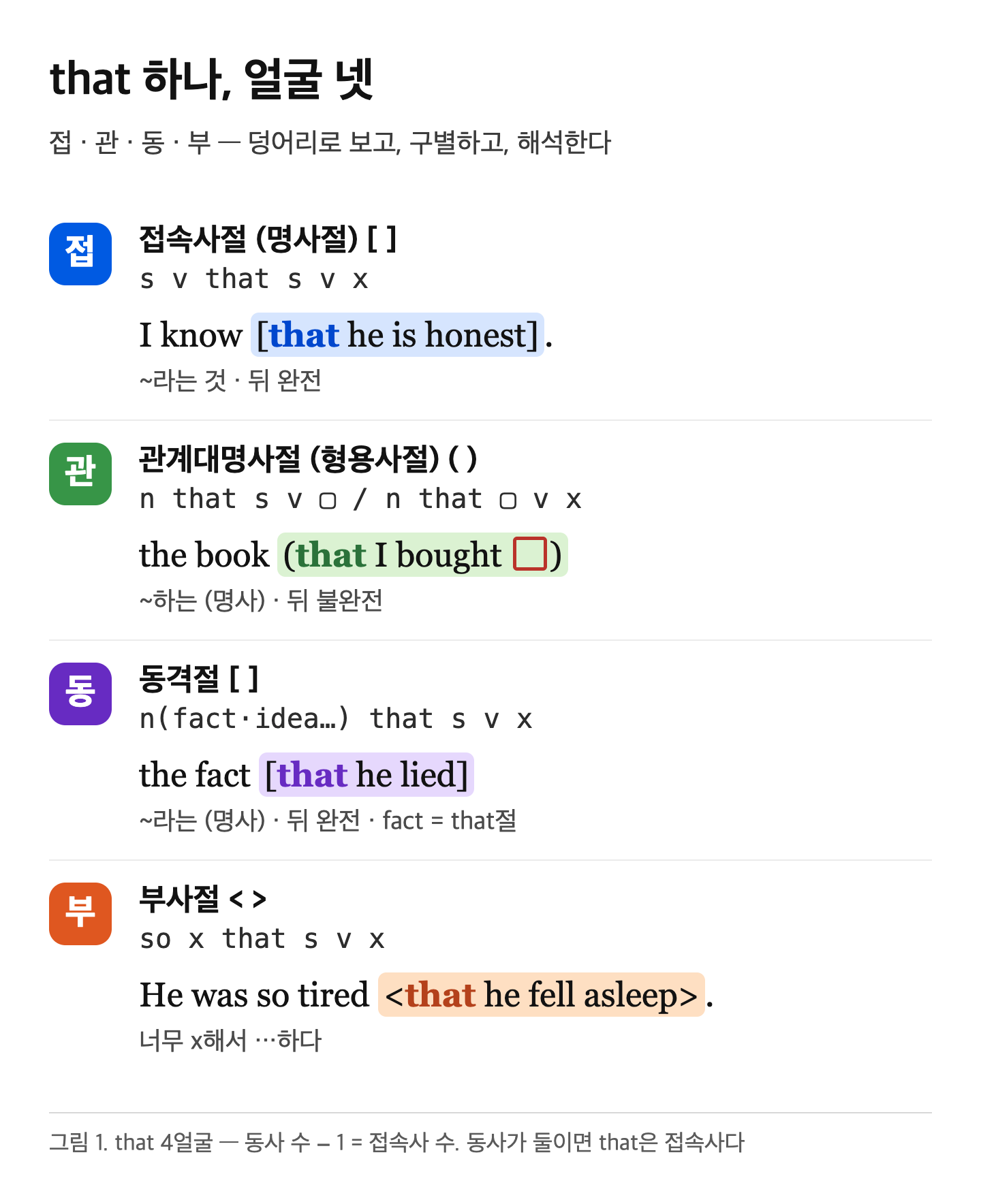
준기 표는 알겠는데, 문장에서 어떻게 골라요?
선생 세 번만 보면 돼. that 앞을 보고, 필요하면 that 뒤를 봐.
0-1 판별 — 앞을 보고, 뒤를 본다
1. that 앞에 so x / such (a) n이 있다 → 부
2. that 바로 앞이 동사다 (s v that) → 접
3. that 앞이 명사다 → 뒤가 불완전(▢)이면 관, 완전하면 동
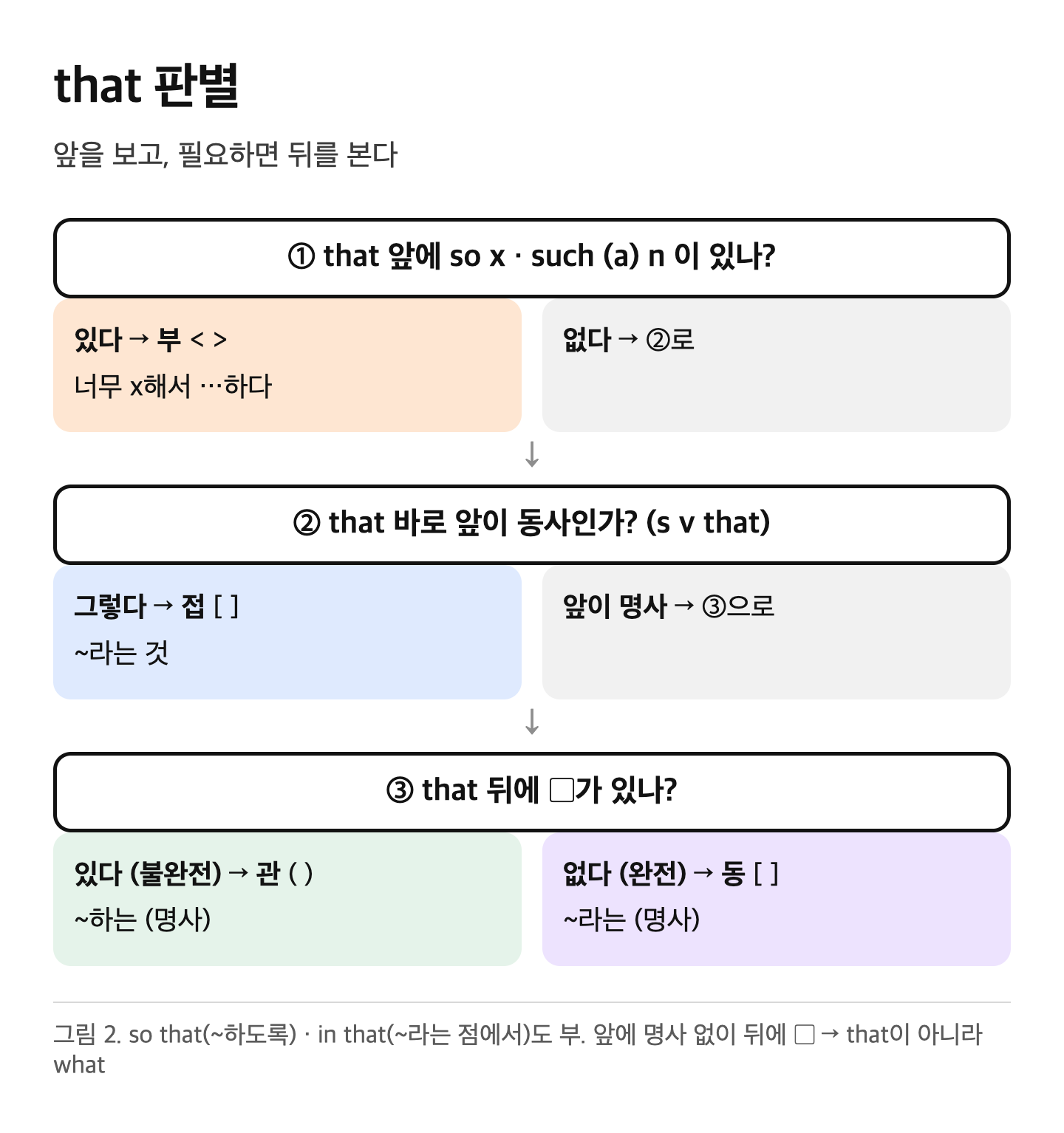
선생 동사 세는 것도 잊지 마. 동사가 두 개면 접속사가 하나 필요하고, 그 접속사가 that이야. 동사 수 − 1 = 접속사 수.
0-2 접 — 접속사절(명사절): s v that s v x
선생 I know that he is honest. 동사는?
준기 know, is. 접속사 that.
선생 know 뒤에 '무엇을'이 와야지? 그 자리에 that절이 통째로 들어갔어. 명사 자리에 들어간 절, 명사절이야.
I know [that he is honest]. 나는 [그가 정직하다는 것]을 안다.
- 목적어: I think [that ~]. / Studies show [that ~].
- 주어: [That he lied] is clear. → 보통 It으로 미룬다. It is clear [that he lied]. (가주어 It, 진주어 that절)
- 보어: The problem is [that we have no time].
준기 뒤는요?
선생 접의 that 뒤는 완전해. s v x가 다 있어. that은 그냥 "~라는 것"이라는 포장지야.
★ that vs what
선생 시험은 여기서 꼭 낸다. 둘 다 명사절을 만드는데 뒤가 달라.
- that + 완전: I know [that he lied].
- what + 불완전: I know [what he said ▢]. (said의 목적어가 비었다 — what이 그 자리를 먹었다)
뒤 완전 → that / 뒤 ▢ → what
0-3 관 — 관계대명사절(형용사절): n that sv▢ / ▢vx
선생 The book that I bought was interesting. 동사는?
준기 bought, was. 접속사 that.
선생 that 앞에 뭐가 있어?
준기 명사 book.
선생 그럼 뒤를 봐. I bought ▢ — 뭘 샀는지가 비었지? 그 빈자리가 앞의 book이야. 뒤가 불완전하면 관이야.
The book (that I bought ▢) was interesting. [내가 산] 그 책은 재미있었다.
The man (that ▢ lives next door) is kind. [옆집에 사는] 그 남자는 친절하다.
- 목적어가 빈 관: n (that s v ▢)
- 주어가 빈 관: n (that ▢ v x)
- 해석: ( )를 "~하는"으로 앞 명사에 거꾸로 붙인다.
준기 5강에서 배운 who, which 자리에 that이 들어간 거죠?
선생 맞아. that = who / which. 그런데 that이 못 들어가는 자리가 둘 있어.
★ that을 못 쓰는 자리
- 콤마 뒤 ✕: My brother, ~~that~~ who lives in Seoul, is a doctor.
- 전치사 뒤 ✕: the house in ~~that~~ which I live
, that ✕ · 전치사 + that ✕
0-4 동 — 동격절: n that s v x
선생 the fact that he lied. 앞에 명사 fact. 뒤를 봐.
준기 he lied. … 다 있어요. 안 비었어요.
선생 앞에 명사가 있는데 뒤가 완전해. 그럼 관이 아니야. 동격이야. fact의 내용이 바로 "그가 거짓말했다"는 거지. fact = that절.
I was shocked by the fact [that he lied]. 나는 [그가 거짓말했다는] 사실에 충격을 받았다.
- 해석: "~라는 (명사)"
- 동격을 데려오는 명사는 대개 생각·말·사실의 명사다.
fact, idea, belief, notion, news, evidence, claim, hope, view, possibility, assumption, premise, conclusion
★ 같은 명사 함정 — 관이냐 동이냐
선생 명사만 보고 동격이라고 하면 틀려. 꼭 뒤를 봐.
- the fact (that he told me ▢) → told의 목적어가 비었다 → 관 "그가 내게 말해 준 사실"
- the fact [that he lied] → 뒤 완전 → 동 "그가 거짓말했다는 사실"
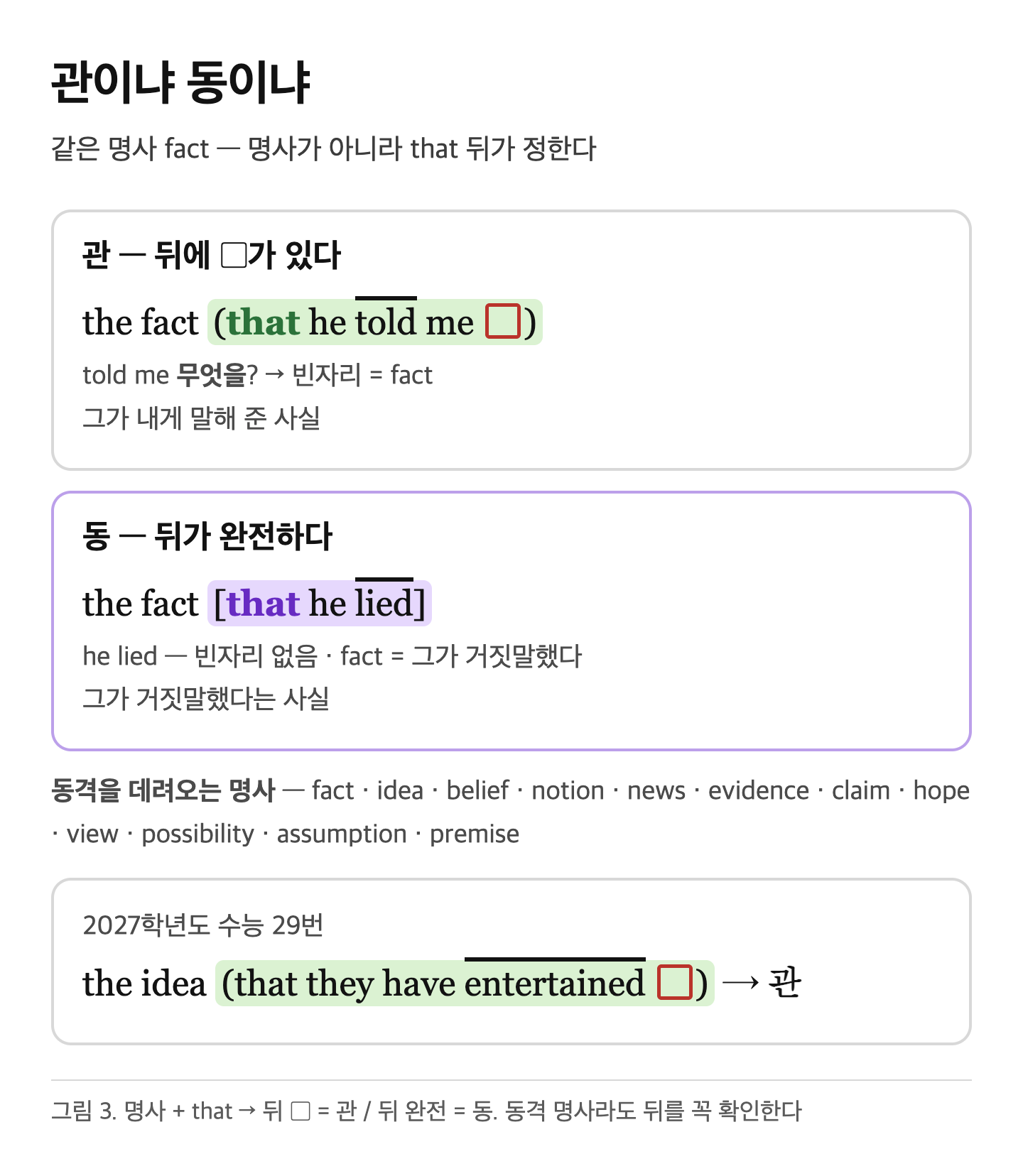
명사 + that → 뒤 ▢ = 관 / 뒤 완전 = 동
0-5 부 — 부사절: so x that s v x
선생 He was so tired that he fell asleep. 동사는?
준기 was, fell. 접속사 that.
선생 that 앞에 뭐가 보여?
준기 so tired!
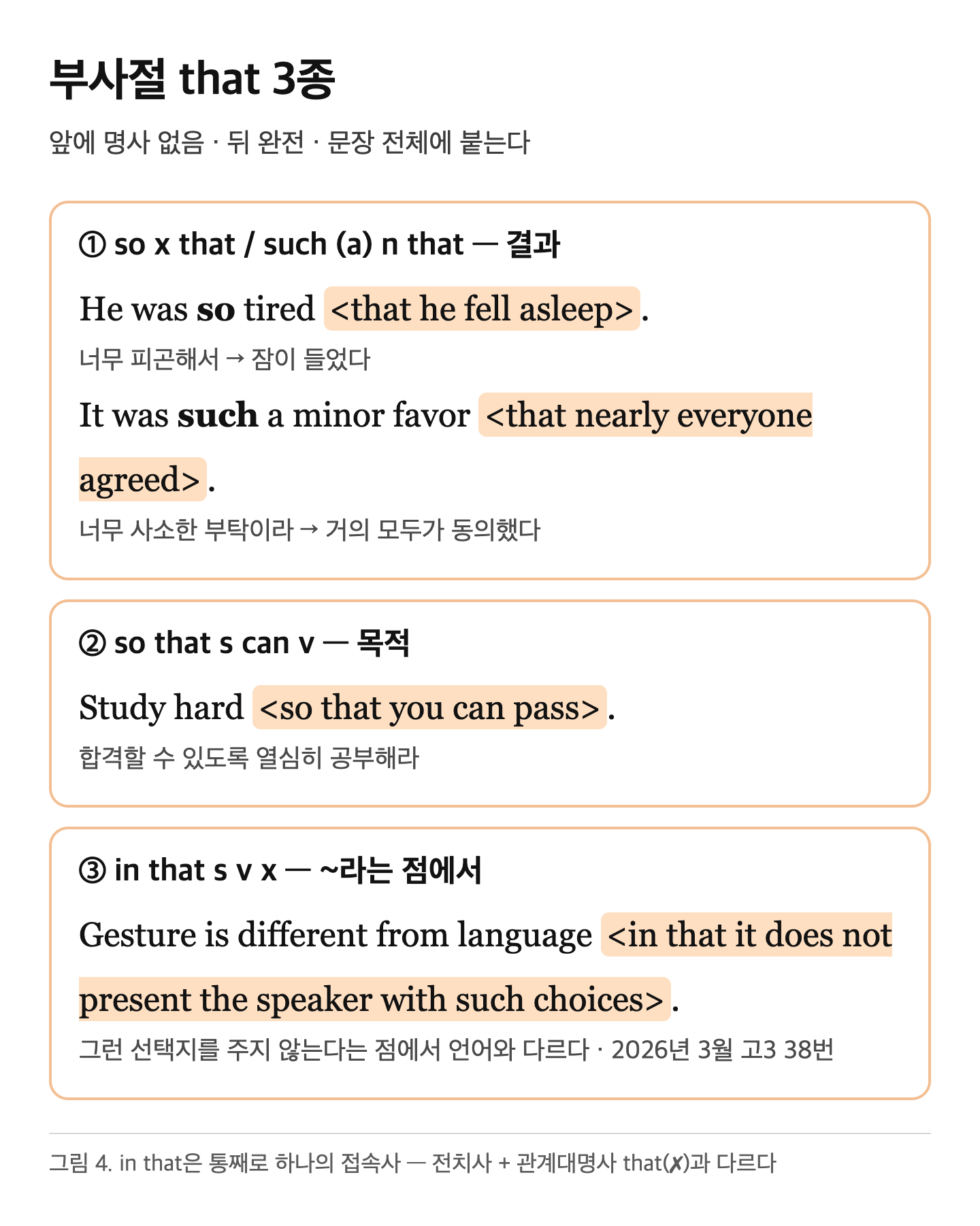
선생 so가 보이면 that은 "그래서"야. 원인 → 결과. 이 덩어리는 문장 전체를 꾸미는 부사절이라 < >로 묶어.
He was so tired <that he fell asleep>. 그는 너무 피곤해서 <잠이 들었다>.
- so + 형/부 + that: 너무 ~해서 …하다
- such (a) + (형) + 명 + that: 너무 ~한 명사라서 …하다
It was such a minor favor <that nearly everyone agreed>. 너무 사소한 부탁이라 거의 모두가 동의했다.
- 해석 순서: 앞에서부터 끊는다. "너무 x해서 → 그 결과 …"
선생 부사절 that은 친구가 둘 더 있어.
- so that s can v: ~하도록 (목적). He studied hard <so that he could pass>. 그는 합격하도록 열심히 공부했다.
- in that s v x: ~라는 점에서. Humans differ from animals <in that they can speak>. 인간은 말을 할 수 있다는 점에서 동물과 다르다.
준기 in that은 아까 "전치사 + that 안 된다"랑 모순 아니에요?
선생 좋은 질문. in that은 통째로 한 접속사야. 뒤가 완전하지? 관계대명사가 아니니까 괜찮아. in which는 뒤 완전 + 앞에 명사, in that은 뒤 완전 + 앞에 명사 없음.
TIP 1. 다섯 번째 that? — It is ___ that 강조구문
It was Tom that broke the window. 창문을 깬 건 바로 Tom이었다.
- 판별: It is와 that을 지워 본다. Tom broke the window. → 문장이 멀쩡하면 강조.
- 가주어 It과 구별: It is clear that he lied. → It is, that을 지우면 clear he lied — 안 된다. 이건 접(가주어).
TIP 2. that이 안 보일 때 — that 생략
- 동사가 두 개인데 접속사가 안 보이면 that이 숨어 있다.
- 접: I think ∅ he is right. → I think [that he is right].
- 관: The book ∅ I bought ▢ was good. → n + s v ▢ (명사 뒤에 바로 주어가 오면 의심)
1설명 — 쉬운 예문 20
that 덩어리를 묶고, 접·관·동·부 이름을 쓰고, 해석한다. 홀수는 풀이를 달았고 짝수는 직접 해 본다.
1-1. 접 5
1I think that she is smart. → I think [that she is smart]. · 접 · 나는 [그녀가 똑똑하다고] 생각한다.
2We know that the earth is round.
3It is true that he won the prize. → It is true [that he won the prize]. · 접(가주어) · [그가 상을 탔다는 것은] 사실이다.
4The problem is that we have no money.
5I can't believe what she said. → I can't believe [what she said ▢]. · what(뒤 ▢) · 나는 [그녀가 한 말을] 믿을 수 없다.
1-2. 관 5
6This is the bag that I lost yesterday.
7The girl that is singing is my sister. → The girl (that ▢ is singing) is my sister. · 관(주어 ▢) · [노래하고 있는] 소녀는 내 여동생이다.
8I like the movie that you recommended.
9The house, which has a red roof, is old. → , which (that ✕) · 관 · 그 집은 지붕이 빨간데, 오래되었다.
10The fact that he told me was surprising.
1-3. 동 5
11The news that she passed made us happy. → The news [that she passed] · 동(뒤 완전) · [그녀가 합격했다는] 소식이 우리를 기쁘게 했다.
12I like the idea that we travel together.
13There is no evidence that he stole it. → evidence [that he stole it] · 동 · [그가 그것을 훔쳤다는] 증거가 없다.
14She ignored the fact that it was raining.
15The idea that you gave me was great. → The idea (that you gave me ▢) · 관(gave의 목적어 ▢) · [네가 내게 준] 아이디어는 훌륭했다.
1-4. 부 5
16It was so cold that the lake froze.
17She is such a kind teacher that everyone loves her. → such a kind teacher <that everyone loves her> · 부 · 그녀는 너무 친절한 선생님이라서 모두가 그녀를 사랑한다.
18Speak louder so that everyone can hear you.
19This plan is good in that it saves time. → <in that it saves time> · 부 · 이 계획은 시간을 아낀다는 점에서 좋다.
20He ran so fast that nobody could catch him.
2연습 — 기출 문장 20
동사에 윗줄을 긋고, that 덩어리를 묶고(접·동 [ ] · 관 ( ) · 부 < >), 접·관·동·부 이름과 해석을 쓴다. 네 얼굴이 섞여 있다.
01Many designers would argue that the most important element of lighting is visibility. 2693-40
02This process is so powerful that it can alter fundamental physiological processes. 2674-37
03Most important, people prefer to develop meanings that are shared with other people. 2692-32
04This is likely due to the fact that adults are better at anticipating stimuli, and hence are more difficult to surprise, than are children. 2693-32
05They found that participants projected their own motives onto others. 2674-32
06When you breathe, for example, only some of the atoms that you inhale are exhaled in your next breath. 2591-21
07Before you face your animal subject, you should study and learn about it so that you can anticipate its behavior. 2613-20
08This phenomenon may reflect the fact that the roots of individualism are in England. 2692-37
09People may believe that training our bodies is unrelated to training our minds. 2663-20
10None of the structures that we use to speak are unique to our species. 2674-33
11The connection between clothing and social status was so pronounced that laws were enacted to limit the wearing of certain luxury items. 2663-29
12When new evidence does not support the idea that they have entertained, they reexamine it from alternative viewpoints. 2613-29
13This bias comes from the fact that we live in a very constant pressure environment. 2632-39
14Yet metaphor has such lasting power that we can use even such dead metaphors to help us gain understanding. 2694-31
15Consider the feeling of encountering a diary that you wrote many years ago. 2433-40
16Numerous experiments have found that if learners simply study in at least two different places, they are more likely to recall the material. 2661-32
17According to McNeil and Duncan, gesture is different from language in that it does not present the speaker with such choices. 2633-38
18That is because geography starts from the premise that it matters where something takes place on Earth's surface. 2563-34
19Mike was so excited that he ran to grab his Arrows hat. 2593-4345
20With advances in cloth making, however, fashion began moving toward styles that were more elaborate and form-fitting. 2663-29
3실전 — 수능·모의고사 어법 2문항
that에 밑줄이 그어진 문항이다. that 앞을 보고, 뒤를 보고, 접·관·동·부 중 무엇인지 먼저 정한다.
실전 1. 다음 글의 밑줄 친 부분 중, 어법상 틀린 것은? 2693-29 · 정답률 72% · 2026년 9월 고3
Leaders come in all shapes and sizes, but successful leaders tend to have one thing in common: the ability to share someone else's feelings, known as empathy. While empathy forms in everyone to some degree, effective leaders know how to develop this emotional guidance system ① to connect with others' feelings and perspectives. However, empathy in leaders is more than ② simply being kind to employees, clients, and customers. Empathetic people seem more approachable, focusing on the words of others. Listening to the needs of employees ③ enable leaders to clearly identify what makes them feel heard. Utilized in this way, empathy can be considered a crucial part of ④ maintaining employee satisfaction. Leaders who are unable to surround themselves with competent employees will not be successful. Indeed, a leader's failure to empathize with talented workers is one of the main situations ⑤ that could lead them to leave an organization. In this case, the organization must spend precious time and money to find suitable replacements for them.
실전 2. 다음 글의 밑줄 친 부분 중, 어법상 틀린 것은? 2333-29 · 정답률 42% · 2023년 3월 고3
From the 8th to the 12th century CE, while Europe suffered the perhaps overdramatically named Dark Ages, science on planet Earth could be found almost ① exclusively in the Islamic world. This science was not exactly like our science today, but it was surely antecedent to ② it and was nonetheless an activity aimed at knowing about the world. Muslim rulers granted scientific institutions tremendous resources, such as libraries, observatories, and hospitals. Great schools in all the cities ③ covering the Arabic Near East and Northern Africa (and even into Spain) trained generations of scholars. Almost every word in the modern scientific lexicon that begins with the prefix "al" ④ owes its origins to Islamic science — algorithm, alchemy, alcohol, alkali, algebra. And then, just over 400 years after it started, it ground to an apparent halt, and it would be a few hundred years, give or take, before ⑤ that we would today unmistakably recognize as science appeared in Europe — with Galileo, Kepler, and, a bit later, Newton.
✓정답·해설
설명 짝수 정답
2. We know [that the earth is round]. · 접 · 우리는 [지구가 둥글다는 것]을 안다.
4. The problem is [that we have no money]. · 접(보어) · 문제는 [우리에게 돈이 없다는 것]이다.
6. This is the bag (that I lost ▢ yesterday). · 관(목적어 ▢) · 이것이 [내가 어제 잃어버린] 가방이다.
8. I like the movie (that you recommended ▢). · 관 · 나는 [네가 추천해 준] 영화가 좋다.
10. The fact (that he told me ▢) was surprising. · 관(told의 직접목적어 ▢) · [그가 내게 말해 준] 사실은 놀라웠다. ★동격 아님
12. I like the idea [that we travel together]. · 동 · 나는 [우리가 함께 여행한다는] 생각이 좋다.
14. She ignored the fact [that it was raining]. · 동 · 그녀는 [비가 오고 있다는] 사실을 무시했다.
16. It was so cold <that the lake froze>. · 부(결과) · 너무 추워서 호수가 얼었다.
18. Speak louder <so that everyone can hear you>. · 부(목적) · 모두가 네 말을 들을 수 있도록 더 크게 말해.
20. He ran so fast <that nobody could catch him>. · 부(결과) · 그는 너무 빨리 달려서 아무도 그를 잡을 수 없었다.
연습 20 정답
01 argue [that the most important element of lighting is visibility] · 접 · 많은 디자이너들은 [조명의 가장 중요한 요소가 가시성이라고] 주장할 것이다.
02 so powerful <that it can alter fundamental physiological processes> · 부 · 이 과정은 너무 강력해서 근본적인 생리 과정을 바꿀 수 있다.
03 meanings (that ▢ are shared with other people) · 관(주어 ▢) · 가장 중요하게, 사람들은 [다른 사람들과 공유되는] 의미를 만들어 가는 것을 선호한다.
04 the fact [that adults are better at anticipating stimuli … than are children] · 동 · 이것은 아마도 [성인이 아이들보다 자극을 예상하는 데 더 능숙해서 놀라게 하기가 더 어렵다는] 사실 때문일 것이다.
05 found [that participants projected their own motives onto others] · 접 · 그들은 [참가자들이 자신의 동기를 다른 사람들에게 투사한다는 것]을 발견했다.
06 the atoms (that you inhale ▢) · 관(목적어 ▢) · 예를 들어 숨을 쉴 때, [여러분이 들이마시는] 원자들 중 일부만 다음 숨에 내쉬어진다.
07 <so that you can anticipate its behavior> · 부(목적) · 동물 대상을 마주하기 전에, 그 행동을 예상할 수 있도록 그것에 대해 공부하고 배워야 한다.
08 the fact [that the roots of individualism are in England] · 동 · 이 현상은 [개인주의의 뿌리가 영국에 있다는] 사실을 반영하는 것일 수 있다.
09 believe [that training our bodies is unrelated to training our minds] · 접 · 사람들은 [몸을 훈련하는 것이 마음을 훈련하는 것과 관련이 없다고] 믿을지도 모른다.
10 the structures (that we use ▢ to speak) · 관(목적어 ▢) · [우리가 말하기 위해 사용하는] 구조들 중 어떤 것도 우리 종에만 있는 것은 아니다. ★주어 None, 동사 are
11 so pronounced <that laws were enacted …> · 부 · 의복과 사회적 지위의 연관이 너무 뚜렷해서 특정 사치품의 착용을 제한하는 법이 제정되었다.
12 the idea (that they have entertained ▢) · 관(entertained의 목적어 ▢) · ★같은 명사 함정. 새로운 증거가 [그들이 품어 온] 생각을 뒷받침하지 않을 때, 그들은 그것을 다른 관점에서 다시 검토한다.
13 the fact [that we live in a very constant pressure environment] · 동 · 이 편향은 [우리가 매우 일정한 압력의 환경에서 산다는] 사실에서 온다.
14 such lasting power <that we can use even such dead metaphors …> · 부(such ~ that) · 그러나 은유는 너무 오래가는 힘을 지녀서 우리는 그런 죽은 은유조차 이해를 돕는 데 쓸 수 있다.
15 a diary (that you wrote ▢ many years ago) · 관(목적어 ▢) · [여러분이 여러 해 전에 쓴] 일기장을 만나는 느낌을 생각해 보라.
16 found [that if learners simply study …, they are more likely to recall the material] · 접 · ★that 바로 뒤에 if절이 끼어 있다. 수많은 실험이 [학습자가 적어도 두 곳에서 공부하기만 해도 내용을 기억해 낼 가능성이 더 높다는 것]을 발견했다.
17 <in that it does not present the speaker with such choices> · 부(in that) · McNeil과 Duncan에 따르면, 몸짓은 화자에게 그런 선택지를 주지 않는다는 점에서 언어와 다르다.
18 the premise [that it matters where something takes place on Earth's surface] · 동 · ★동격절 안에 가주어 it. 그것은 지리학이 [어떤 일이 지구 표면의 어디에서 일어나는지가 중요하다는] 전제에서 출발하기 때문이다.
19 so excited <that he ran to grab his Arrows hat> · 부 · Mike는 너무 신이 나서 Arrows 모자를 잡으러 달려갔다.
20 styles (that ▢ were more elaborate and form-fitting) · 관(주어 ▢) · 그러나 옷감 제작이 발전하면서, 패션은 [더 정교하고 몸에 꼭 맞는] 스타일로 나아가기 시작했다.
실전 정답
실전 1. 정답 ③ (enable → enables) · 정답률 72%
- ⑤ that은 맞다. 앞에 명사 situations, 뒤 ▢ could lead them … (주어 ▢) → 관. "조직을 떠나게 만들 수 있는 주요 상황들 중 하나".
- ③ 주어는 동명사 Listening to the needs of employees(단수) → enables.
실전 2. 정답 ⑤ (that → what) · 정답률 42%
- before 뒤에 [ ⑤ we would today unmistakably recognize ▢ as science ] appeared in Europe. 덩어리 전체가 appeared의 주어다.
- 앞에 명사(선행사)가 없다 → 관 ✕. 뒤가 불완전(recognize의 목적어 ▢) → 접 that ✕.
- 앞 명사 없음 + 뒤 ▢ = what. "우리가 오늘날 과학으로 틀림없이 인정할 것"
- ★0-2의 that vs what 그대로다. 뒤 완전 → that / 뒤 ▢ → what.